
There are a few key unresolved issues in our sector and we are sitting on our hands waiting for action. The transformation of TVNZ into a proper public broadcaster is one. Then there’s the Screen Industry Worker Bill that will allow contractors to engage in collective bargaining. Another, the underwriting insurance needed to get the domestic film industry up again.

I know there is an election on, but we are still some ways away from the transformational change needed to get going properly, as well as grasp the opportunities on offer in the new world we are in.

In the UK, the new Director General of the BBC is moving rapidly to address the challenges there. Amongst them the COVID-19 pandemic, lack of diverse representation, political pressure, pay disparity, technological disruption, the emergence of competing news outlets, a battle to maintain relevance and the threat to the licence fee. A number of his changes will undoubtedly prove unpopular as he drives the organisation to be leaner and more commercial as well.

Yet here we sit still waiting for the Government to address the public broadcaster issue. It was December last year when Broadcasting Minister Kris Faafoi proposed merging TVNZ and RNZ. In January, he presented a revised plan and was asked for a business case due last month. Meanwhile, streamers have become the new global studios, YouTube has become the most popular source of video content in New Zealand, and TVNZ continues to lose money. The only wait that’s been blessedly terminated is what’s happening to TV3. The good news is Discovery’s acquisition of some of Mediaworks assets including the network—perhaps the first time in the channel’s history that it’s going to have real money in the bank to draw on.

Starting in 2018, the Film Industry Working Group toiled for months to unanimously come up with recommendations to help shape the Screen Industry Worker Bill. This extended process together with the time to draft the Bill, the Select Committee submissions and the interruptions caused by COVID mean we have to accept there will be no passage of the bill into law prior to the election. We are now faced with its fate hanging on the election result. Even after all the Select Committee submissions were predominantly in support of the Bill, National continue to oppose it. They will throw it out if they come into power. Accepting the rejection of the Hobbit Law they were responsible for putting in place would obviously be too much for them.

Perhaps the biggest stumbling block for the industry right now is the lack of commitment from our Government to underwriting the local film industry, replacing the insurance companies who won’t insure for COVID. In June, the Australian Government put in place an AUD$50 million fund to provide financial guarantees because insurance companies are not providing coverage for COVID-19. In July the British government launched an emergency £500M (US$646M) film and TV coronavirus production insurance fund. NZFC and SPADA have already made representations to Government to underwrite local production. Nearly two months later and we still haven’t heard an answer.

I know that the New Zealand screen sector has received monies to address the impact of COVID. We are all thankful for that. But this underwriting is necessary if any new New Zealand films are going to get made. Here’s hoping we don’t have to wait too much longer to find out.


Tui Ruwhiu
Executive Director


Last updated on 17 September 2020
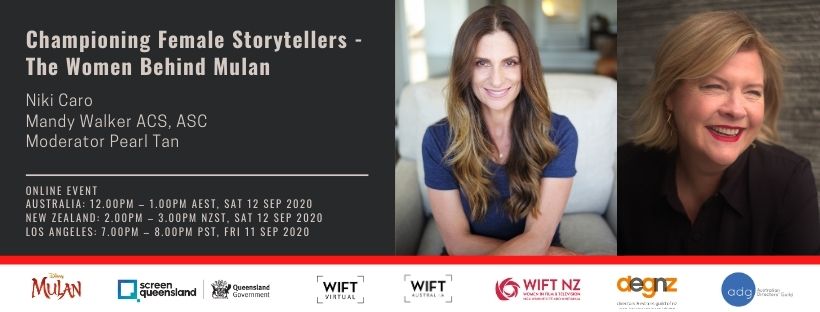
Meet the powerful collaborators behind Disney’s Mulan: Director Niki Caro (MNZM) and Cinematographer Mandy Walker (ACS, ASC) at WIFT Virtual’s Excellence in Craft Episode 3


When:

Australia: 12.00pm – 1.00pm AEST, Saturday 12th September 2020
New Zealand: 2.00pm – 3.00pm NZST, Saturday 12th September 2020
Los Angeles: 7.00pm – 8.00pm PT, Friday 11th September 2020

How:

To attend this event registration is required. Free for DEGNZ and WIFT NZ members and by donation for non-members. Register with Eventbrite HERE

WIFT Australia is proud to present these two outstanding filmmakers in conversation online to share their unique insight into the creative process of Disney’s live-action production Mulan.

Mulan was shot in New Zealand and China in 2018. The dynamic on-set team, director Niki Caro (MNZM) and cinematographer Mandy Walker (ACS, ASC) came together for this historic project.

This event is also notable as WIFT Australia’s first major collaboration with WIFT NZ.

“WIFT Virtual is honoured to offer members and a global audience the opportunity to listen and learn from these two talented women. Mulan is a landmark for gender representation on set. We hope Disney’s lead inspires other production companies to hire more female teams” says Katrina Irawati Graham, Chair of WIFT Australia.

In this intimate conversation Caro and Walker will also share personal success stories and tips on maintaining creative drive during the COVID-19 lockdown. An opportunity will be provided for the audience to post questions for the Q&A segment.

Disney’s Mulan begins streaming September 4, exclusively available to Disney+ subscribers with Premier Access. Additional fee required.

WIFT Virtual’s Excellence in Craft Episode 3 will be held online Saturday 12th September at 12-1pm AEST/Friday 11th September at 7-8pm PST

About the Speakers

Niki Caro’s (Director) first feature, “Memory & Desire” (1997), was in the lineup at the Cannes Film Festival and won a Special Jury Prize at the New Zealand Film Awards. Her second feature film, “Whale Rider,” won 27 international awards, at prestigious international film festivals such as Toronto, Sundance, Rotterdam, San Francisco, Seattle and Maui. The film earned an Academy Award® nomination for Keisha Castle-Hughes.

Caro then directed “North Country,” starring Charlize Theron, Frances McDormand, Sissy Spacek and Woody Harrelson. Theron and McDormand were nominated for best actress and best supporting actress respectively at the 2005 Academy Awards®, Golden Globe® Awards, BAFTAs, Satellite Awards and Screen Actors Guild Awards®. Caro’s more recent feature-length films include “A Heavenly Vintage,” “McFarland, USA,” “The Zookeeper’s Wife.”

Mandy Walker (Cinematographer) has shot 18 feature films, including “The Mountain Between Us” (2017), “Hidden Figures” (2016), “Truth” (2015), “Tracks” (2013), “Australia” (2007) and “Shattered Glass” (2003), along with many commercials. She has been the recipient of many cinematography awards over the years.

Walker is also on the board of governors of the Academy of Motion Picture Arts and Sciences and is on the board of American Society of Cinematographers; an accredited member and Hall of Fame honoree of the Australian Cinematographers Society; an executive member of Women in Film; and a board member of the NEB of the IATSE Local 600.

Pearl Tan (moderator) is currently the Senior Lecturer in Directing at the Australian Film Television and Radio School (AFTRS) overseeing the Directing stream in the undergraduate program.

She was Co-Founder and Co-Chair of the Equity Diversity Committee within the Media Entertainment and Arts Alliance (MEAA) and held positions on the MEAA Board and the National Performers Committee (NPC) for Actors Equity. She has been in the AFTRS Council, on the Screen Australia Gender Matters Taskforce, and was NSW Chapter Head for the Australian Directors Guild (ADG). Currently, she sits on the board of Critical Stages Touring and the ADG. She was also named a Woman of Influence by the Australian Financial Review and Westpac in 2016.

About WIFT Virtual

WIFT Virtual is a series of online events in 2020 produced by Yolandi Franken of WIFT NSW (WIFT Virtual Chair). WIFT QLD committee Events Manager Karolina Berkell-Kirk is the producer of the limited series Excellence in Craft.

This episode is sponsored by Screen Queensland, WIFT NZ, The Directors & Editors Guild of New Zealand, Disney’s Mulan and is supported by the Australian Directors Guild.

About WIFT NZ

WIFT NZ is the largest pan-industry professional organisation in the Aotearoa New Zealand screen sector. A number of its members worked on Mulan and we celebrate Disney’s recognition of director Niki Caro, female talent, and commitment to diversity with this exciting eagerly-awaited film.

Screening links for media only, available upon request.

About Mulan

Acclaimed filmmaker Niki Caro brings the epic tale of China’s legendary warrior to life in Disney’s “Mulan,” in which a fearless young woman risks everything out of love for her family and her country to become one of the greatest warriors China has ever known. When the Emperor of China issues a decree that one man per family must serve in the Imperial Army to defend the country from Northern invaders, Hua Mulan, the eldest daughter of an honored warrior, steps in to take the place of her ailing father. Masquerading as a man, Hua Jun, she is tested every step of the way and must harness her inner-strength and embrace her true potential. It is an epic journey that will transform her into an honored warrior and earn her the respect of a grateful nation…and a proud father.

“Mulan” features a celebrated international cast that includes: Yifei Liu as Mulan; Donnie Yen as Commander Tung; Tzi Ma as Zhou, Jason Scott Lee as Böri Khan; Yoson An as Honghui; Ron Yuan as Sergeant Qiang; with Gong Li as Xianniang and Jet Li as the Emperor. The film is directed by Niki Caro from a screenplay by Rick Jaffa & Amanda Silver and Lauren Hynek & Elizabeth Martin, suggested by the narrative poem “The Ballad of Mulan.” The producers are Chris Bender, Jake Weiner and Jason Reed, with Bill Kong, Barrie M. Osborne, Tim Coddington and Mario Iscovich serving as executive producers.

Last updated on 10 September 2020

2020 is a watershed year in time for the screen industry because of COVID and the Level 4 lockdown we endured.

New Zealand On Air’s latest ‘Where Are The Audiences’ research was conducted during May and June, when we had come out of Level 4 and were in Levels 2 and 1.

Although potentially skewed because of COVID and possibly having an irreversible effect when it comes to content viewership that’s too early to truly gauge, the results make interesting reading, and potentially signal the writing is on the wall for free-to-air TV2 with its target audience of 18 – 49-year-olds.

Two’s popularity with all New Zealanders 15+ showed a continued decline from 27% in 2014 to 14% in 2020. More telling is that from 2018 when the survey was last conducted to now, The channel’s popularity declined by 7%, its biggest drop for the two-year periods across which the surveys have been conducted since 2014.

The research indicates that 2020 is the crossover point between traditional media and digital media for attracting the biggest daily audiences of New Zealanders overall with YouTube video now the most popular site, station or channel. But for 15 – 39-year-olds, a large part of Two’s audience, that crossover point occurred in 2018 or earlier.

Exacerbating the problem for Two is the increased adoption of digital media by those aged 40 – 59, containing the remaining chunk of the channel’s audience. This 40 – 59 age group is moving away from free-to-air TV and towards SVOD, OnDemand, and other digital options.

2020 would seem to be the cross over point for the 40 – 59 year-old shift from traditional to digital media.

On the bright side for TVNZ, OnDemand popularity is increasing, rising from 7% in 2014 to 21% in 2020.

Coincidentally, the percentage increase in popularity of OnDemand is essentially the same as the decrease in popularity of TV2 at 6 – 7%.

The younger demographics are digital natives or early digital adopters and as time passes the older age groups are utilising digital more on more. While free-to-air viewing remains stable, you’ve got to wonder how much more of a decline Two can take with its core demographic before it becomes unsustainable for TVNZ, who are contributing to Two’s audience cannibalisation with TVNZ OnDemand.

We’ll likely know come the next survey results in 2022.


Tui Ruwhiu
Executive Director

Last updated on 2 September 2020