
Piggy bank wearing a surgical mask

If your income or business has been impacted by Alert Levels 3 and 4, you may be eligible to apply for financial support. As many directors and editors are self-employed, this is an overview of what support is available from the New Zealand Government to help sole traders and the self-employed.


Wage Subsidy August 2021

Self-employed people and sole traders anywhere in New Zealand can apply for the Wage Subsidy Scheme through the Work and Income website if they are eligible. It’s paid as a two-week lump sum to support businesses that have experienced a decline in revenue attributed to the continuation of Alert Levels 3 and 4.

Each round opens for two weeks. Applications for the fourth round, Wage Subsidy August 2021 #4, opened on Friday 1 October and will remain open until 11.59pm on Thursday 14 October.

Resurgence Support Payment (RSP)

The COVID-19 Resurgence Support Payment helps to cover wages and fixed costs for businesses who have been directly affected when there is an increase to Alert Level 2 or higher for a week or more. Sole traders can receive a payment of up to $1,900.

When applications open in MyIR, they will also remain open for one month after all of New Zealand returns to Alert Level 1.

  • Applications for the 1st payment under the alert level increase announced on 17 August are still open.
  • Applications for a 2nd payment under the RSP opened on 17 September.
  • Applications for a 3rd payment will open on 8 October.

Small Business Cash Flow Loan Scheme (SBCS)

The Government will provide loans to small businesses, including sole traders and the self-employed, impacted by COVID-19 to support their cash flow needs. Applications are open through myIR until 31 December 2023. This is a loan so you will need to pay it back, but it’s interest free if you pay it within 2 years.

COVID-19 Short-term Absence Payment

A one-off $359 payment when you cannot work from home and you:

  • need to stay at home while waiting for a COVID-19 test result.
  • need to stay home and look after a dependent child who has been asked to get a COVID-19 test.
  • live with someone who has been at a location of interest and need to stay home while they wait for the person in the household to get a negative test result.

You can apply for it through Work and Income at any time, but cannot be taken while you receiving the Wage Subsidy August 2021 or Leave Support Scheme.

COVID-19 Leave Support Scheme

This scheme provides self-employed people with an income, paid at a flat rate, if they cannot work from home while they’re self-isolating. You need to meet certain criteria to apply.

More information can be found at Work and Income. But note that you can’t get more than one COVID-19 payment at the same time.

Other Support

If you are still having trouble meeting your needs, you might be able to get help from the Ministry of Social Development (MSD). You do not need to be on a benefit to get help with urgent costs, such as medical costs, rent or mortgage payments and utility bills.
Use this tool to check what you might get.

Advice for self-employed people with tax-related concerns:
https://www.ird.govt.nz/covid-19/business-and-organisations/self-employed


The above information is provided as an overview guide only based on the COVID-19 financial support tool at www.covid19.govt.nz. Make sure you read the official information provided by IRD, MSD and the Ministry of Business, Innovation and Employment to decide which support best suits your personal situation.

Last updated on 7 October 2021
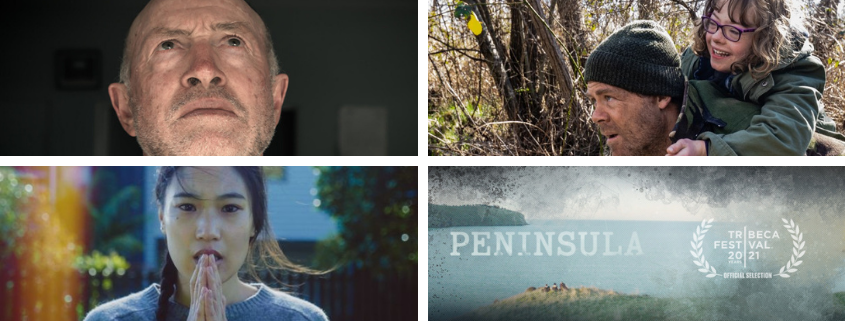
The New Zealand International Film Festival has announced that local shorts will also screen before selected feature films in Auckland and Wellington, on top of the NZ’s Best and the Ngā Whanaunga Māori Pasifika short film sections. Keep an eye out for these five short films by DEGNZ members.

The Man Downstairs

Director/producer and DEGNZ member Grant Lahood will have his short The Man Downstairs  screened this year during the festival. The premise is mysterious as young couple Jess and Tom move into the perfect new apartment upstairs from their landlord Colin, but then things start getting strange.

Marieville

Grant Lahood also has another short film screening, one he wrote, directed and produced called Marieville. Marieville is centred around Karen and a sudden encounter with an icon from her past that conjures evocative memories of her late father and his passion for a model Mississippi paddle boat.

The Meek

The storyline for The Meek simply couldn’t be more timely: in a twist of chromosomes and fate, young Izzy may also be the key to humanity’s future in a world ravaged by a deadly virus. The short film set to screen at this year’s festival is directed and written by DEGNZ member Gillian Ashurst and edited by Jonathan Woodford-Robinson.

Munkie

DEGNZ board member Steven Chow will see his film Munkie screened in Auckland and Wellington during the festival too. Steven wrote, directed and edited Munkie which tells the story of Rose and her violent plan for revenge against her domineering tiger parents.

Peninsula

In the film Peninsula, Mark is pushed out of his comfort zone while trying to reconnect with his estranged son Toby and deal with his new neighbour Amber who does things differently. Written and directed by Fiona McKenzie and edited and produced by Scott Flyger, Peninsula has done extremely well internationally and we are excited to have it screen on our shores again.

Last updated on 7 October 2021

Congratulations to our DEGNZ members whose short films have been selected to compete in this year’s Ngā Whanaunga Māori Pasifika Shorts.

Disrupt

Our very own Margot Francis (DEGNZ board member) was the supervising editor while Lisa Greenfield edited Disrupt. In the aftermath of a burglary gone wrong, CJ must choose between his whānau or his next fix.

Sista

Co-written and directed by member Chantelle Burgoyne, produced by Marina McCartney and cut by DEGNZ board member Annie Collins, Sista is about the relationship between Isabelle and her teenaged older sister Tiana. Isabelle feels left behind as Tiana grows up, leading to a moment of betrayal that threatens to shatter their relationship forever. Both Chantelle and Marina are alumni of the DEGNZ Emerging Women Filmmakers Incubator.

In total, five short films from Aotearoa and the Pacific were shortlisted to compete for the two grand prizes up for grabs; the Wellington UNESCO City of Film award for Best Film and the Letterboxd Audience Award.

Read more about the competition

Last updated on 7 October 2021

Six short films have been selected as finalists for Whānau Mārama: New Zealand International Film Festival’s New Zealand’s Best Short Film Competition. Amongst those selected by Guest Selector, award-winning actress and filmmaker Kerry Fox, are films made by our very own DEGNZ members.

Only F**ks Pat Me on the Head

Only F**ks Pat Me on the Head is an intimate documentary about John, a Wellingtonian with Cerebral Palsy, as he shares the frustrations of living with CP in a world not designed to accommodate those who are different. This short doco is co-directed and co-produced by DEGNZ member Paul Wolffram.

Datsun

In Datsun, fourteen-year-old Matt takes his dad’s yellow Datsun for one last wild joyride with his best buddy and kid brother in tow. DEGNZ member Luke Haigh was the editor of the film.

A total of four prizes are to be won; The Vista Group Award for Best Short Film, the Creative New Zealand Emerging Talent Award, the Auckland Live Spirit of the Civic Award and The Audience Award.

Read more about the competition

Last updated on 18 November 2021

There are a few options available to enable editing with your director, or if you are assisting your editor, when you’re unable to be in the same room or premises. There are both low and high end options depending on budget constraints.


DEGANZ board member Margot Francis has been editing remotely during the level 4 lockdown and describes the Low end system she uses:

Zoom has a screen sharing feature which we are using. It works mostly pretty well, the director can see my timeline in real time and we can talk etc but there is a lag when we actually want to screen the cut on the director’s end so we do an QT output and upload to them.

We also send bins back and forth – the important thing in editing remotely like this is that the media has to be mirrored – the editor, director, and post house have to have mirrored media. In our case all media has to go first to the post house and then sent to editor/director.

I am also using Chrome Remote Desktop – kind of like Teamviewer so that I can communicate easily with the post house about importing new media. We haven’t checked whether we can also screen remotely.

We have an FTP site for importing avid media – installing software such as Filezilla or PC/Mac or Cyberband.

For me all this takes longer but I’m sure there are other ways to go.

There are some workflow considerations connected to mirroring the media. This upload of April 2020 sets them out clearly – go to point 2. Islands of Media.

And while you’re there, check out point 5. Media in the Cloud: Avid Edit on Demand which is an early background on Avid EOD.

Which takes us to CLOUD BASED, High end solutions:

James Brookes of Department of Post uses a Cloud option:

There are plenty of options. We have a film using Evercast at the moment, check out their video here.

We can also achieve a similar thing through our Light Post setup where we send the NDI stream from Avid to the input of Zoom. That gets you the full frame out of the Avid to a Zoom window.

We also use H265 encoders to send SDI streams to producers’ homes; they connect a stream in VLC and can see the Avid output.

Images & Sound also offer Evercast which they find very reliable, being able to stream full HD. Andrew Ross of I&S says, “It is an all-in-one solution that we have used with some big name productions, including Netflix jobs and a couple of overseas movies that were edited here so it seems to pass the security tests put in place by those companies.”

Images & Sound are also test driving Moxion’s new Realtime feature. A laptop may still be required for communication where Zoom/Skype is required.

During 2020, ex-Kiwi Director Martin Campbell was using Evercast while filming The Protégé in Europe with his editor in LA, and describes the experience here.

Working from Park Road Post Production, Assistant Editor Scott Milligan is working on Avid Edit on Demand to support his editor in Los Angeles. Scott shared the following:

Below is an interview I did with Avid along with my current remote workmates, about working on Avid Edit On Demand, and gives a rough overview of how it works. This was early on in the project, we have since advanced our workflow, and are now able to automatically sync media and bins between systems.

Scott’s interview is Avid Post Cafe Episode 4 – Global Production.

Avid will set you up with a plan to suit your project. This will be a set cost per month based on the number of virtual machines, TBs of storage, uploading and downloading of data, as well as time logged.

During a conversation with Scott, the following points came up:

With Avid EOD (and Evercast), files are uploaded to the Cloud and are then accessible by as many users you want – no need for drives or big uploads to be shuffling between locations.

Essentially you are remoting into a machine which is connected to a Nexis server, so most ways work the same way as working off a Nexis in a post facility.

As you are remoting to another machine, your local machine doesn’t need to be powerful. Avid EOD will work well off a mac mini.

NDI in Avid can be used to output your video signal via software such as Zoom or Evercast.

Make sure you have good fibre internet. WIFI signal can fluctuate – So it’s better to be wired in. Think of it like a pipeline from Avid EOD to you – anything along that pipeline can cause the information to move slowly.

Depending on your distance to the server you choose, there can be latency issues. For example, using a server in the USA from NZ results in about a four frame delay.

Trying to keep it simple is best – Share cuts to several people at once using software like PIX or Moxion. Work with the director, sharing the video signal via NDI, and talk via audio call. Setup automatic syncing of data using transfer folders via Dropbox, Resilio, or Filecatalyst Hotfolder.

Most of Avid Edit on Demand detail can be found here.

Both Evercast and Avid EOD are high end products and charge accordingly. They can be set up inside 24 hours with no additional hardware.

Scott also recommends the cheap remote desktop app Jump Desktop.

Last updated on 30 June 2022