
View from the Top banner

We have just wrapped the eighth and last Emerging Women Filmmakers Incubator. This also brings to a close the year-long Incubator programme in its current manifestation as we have been unable to secure funding for it.

In reflecting on women directors working in the scripted space, either in feature film or TV drama, it would seem some improvement has been made from when the Incubator programme began in 2016.

One of the reasons we were prompted to develop the Incubator programme was that there were very few women directing in high-budget scripted drama in New Zealand at the time.

In its 2023 Gender Diversity Report, NZ On Air stated that:

  • Since 2016, male directors have outnumbered female directors. However, 2023 saw the most even split between them since this report began.
  • 50.6% of directing roles were filled by men and 48.2% were filled by females. In 2022, male directors accounted for 53% and female directors made up 46%. […] One project Kainga, which had eight female directors, impacted this data. However, 2023’s figures indicate a significant increase in gender parity from 2016 and 2017’s figures, which showed that men filled around two-thirds of directing roles.

NZ On Air’s stats cover Drama, Documentary and Children’s. While these figures are positive, what is helping these numbers is that more women are directing scripted in the lower budget space—Anecdotally, I think we are safe to say that male directors still dominate in high-budget scripted drama.

Over at NZFC according to statistics I gleaned from their website, of the 12 films funded in the 2015/2016 year for production that went on to get made, five (42%) were directed by women and seven (58%) by men. Interestingly, while women tend to direct more documentary features than men, all seven films directed by men in 2016 were documentary, while only one documentary was directed by a woman.

I need to point out that the numbers I used (from the NZFC website) vary slightly from a published Gender Report by NZFC in September of 2019. In that report, it states that 13 films were funded that year, of which 31% had a woman director and 69% had a male director. It may well be that one of the films ultimately didn’t get made, which is what may have changed the numbers available now.

In this year to date (2023/2024), five (50%) of the funded  films are to be directed by men with two of them documentaries, while five (50%) films will be directed by women, two of them documentaries as well. (NB: The two documentaries attributed to each gender are in fact only two documentaries in total, as they will be co-directed with each having one male director and one female director.)

Across the period from 2015/2016 to 2023/2024, the gender balance in feature film directing became a little more favourable to women.

Of the 89 films funded and made during that period 48 (54%) were directed by men while 41 (46%) were directed by women. (Premium Fund projects are not included here as there were both features and TV series made with the now defunct Premium Fund funding.)

Documentaries directed by women during the period were 19 (56%) of the total of 34 doco films, while men directed 15 (44%) of the 34.

Of course there were swings and roundabouts across that 2015/16 – 2023/24 period both in terms of gender as well as the split between narrative and documentary, but overall there is still a slight weighting towards men directing 48 (54%) films over women directing 41 (46%). Narrative films make up 56 (63%) of the 89 films funded versus 33 (37%) for documentary.

With regard to the Emerging Women Filmmakers Incubator, 54 women went through the programme during the 2015/16 – 2023/24 period.

Five of them have directed features in that time (two completed, two in post and one shooting at the time of writing). All of the women from the Incubator have gone on to direct one or more shorts, web series or scripted series, commercials, or other scripted content. There is undoubtedly more to come, with many features and series in development with them.

I think it’s important to note the time frame of features with an example: In the very first intake of directors into the Incubator in 2016, one of the directors came in with a project that is being shot now in 2024, eight years later.

When we started the Incubator, we stated that the intent of it was to help women directors advance their project and careers. I firmly believe that we, being the guild and the many experienced practitioners from the industry who contributed their time and knowledge to the programme, did that.

But more importantly in my view, was that the Incubator gave women directors the opportunity to grow their skills, capabilities and networks, celebrate their successes, and help to address their concerns and fears in a safe space within a like-minded group they could be open with.

We’ve come a long way in addressing inequity for women directors in our industry. But we still have a ways to go. I’m proud that DEGANZ has played a small part in the progress to date.

Tui Ruwhiu
Executive Director

Last updated on 21 November 2024
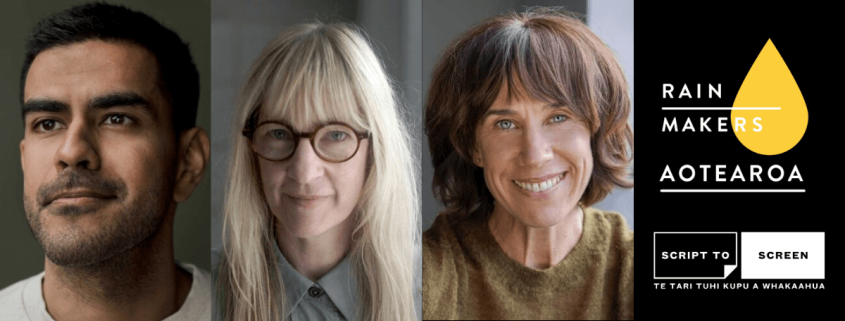
From 100 applications submitted, Script to Screen selected DEGANZ members Pulkit Arora, Armagan Ballantyne, and Jackie van Beek for its new innovative mentorship programme, Rainmakers Aotearoa.

After narrowing applications down, Script to Screen interviewed 12 short-listed applicants to hear more about what they hoped to get from the programme, the type of mentor they were looking for, and where they saw this mentorship taking them in the future. From there, six applications were successful, with five being solo endeavours and Armagan and Jackie participating as a team with the project WONDERLA*.

The initiative aims to nourish Aotearoa’s screen sector by connecting seasoned creatives with the next generation of changemakers. Led by David Court of Compton School in Australia, Rainmakers will be a mix of personalised mentoring, in-person seminars, and online business clinics. The participants will get to collaborate with their Australian counterparts and will attend a seminar during the Melbourne International Film Festival next year. Australian participants will then join the final in-person session in Tāmaki Makaurau Auckland at the end of 2025.

Read more about this year’s participants and the programme on Script to Screen’s website.

Congratulations Pulkit, Armagan, and Jackie!


Last updated on 21 November 2024

The Rotorua Indigenous Film Festival (RIFF) ran last week, with multiple DEGANZ members’ work screening. The intense, three-day festival is a hub of Indigenous films, networking, and industry workshops. Created and run by Māori filmmakers, the festival is based around the values of manaakitanga and kotakitanga.

Ngā Aho Whakaari’s Aho Shorts 2024 Collection premiered during the festival, including DEGANZ member Richard Curtis‘ short Rapido. Also during the festival, Vea Mafile’o (DEGANZ) spoke on a panel presented by PISA called “You Only Get One Chance,” discussing navigating the screen industry as a Pacific Islands filmmaker in Aotearoa.

RIFF Pitch-Slap

Pitch-Slap is RIFF’s funding opportunity for Māori filmmakers. DEGANZ member Denise Edmonds won last year with her project Mōrearea, which was featured in this year’s screening event.

Mōrearea

Director: Denise Edmonds

A woman is haunted by a mysterious, otherworldly presence that uses earthquakes to communicate. As she’s drawn to a geothermal space, she must confront the spirit and uncover a deeper connection through the waters of another realm.


Indigenous Short Film Selection

Lea Tupu’anga / Mother Tongue

Director: Vea Mafile’o

Katherine, a young speech therapist of Tongan and European heritage has lied about her Tongan language skills to work with Siaosi – an elderly Tongan patient with aphasia who has lost his ability to speak English.


Ngā Aho Whakaari Short Films

Rapido

Director: Richard Curtis

A Young Māori boy’s fascination with war comics hits closer to home than he ever imagined.


Last updated on 21 November 2024

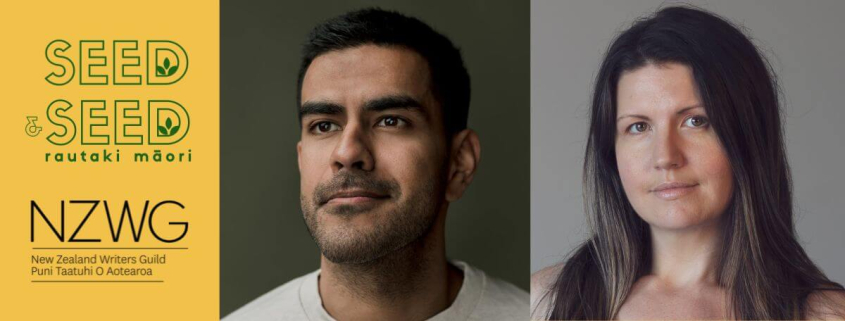
Congratulations to DEGANZ members Pulkit Arora and Jayde Hudson for receiving writing grants from the New Zealand Writers Guild’s (NZWG) 2024 Seed Round.

Each round offers different types of funding aimed at writers of different experience levels. Seed offers six grants of $10,000 for the development of a first draft of a feature film script. Meanwhile, Seed Advanced is a more flexible and higher grant for experienced screenwriters. This round introduced Seed Rautaki Māori to support an emerging Māori screenwriter on their feature film development pathway.

This year, competition was tough as NZWG received 112 Seed and 36 Seed Advanced applications, marking the highest number of submissions to date. Judges Kathryn Burnett (Aotearoa), Sav Rodgers (USA), Mukilan Thangamani (Australia), and Cher Zimmerman (Germany) made up this year’s selection panel.

This year, Pulkit was one of six writers to receive Seed funding while Jade was the sole recipient of the Seed Rautaki Māori grant. Read more about their project below:

Pulkit Arora

The Last Prince

A blue-eyed Indian prince pretends to be white to start a new life with his family in 1925 Australia, only to be forced to accept the heritage he abandoned and resist the colonisation he abetted.

Jayde Hudson

Nevermind

In the mid-90s, a freewheeling ten-year-old navigates a new world of bullies and other dangerous creatures when her family relocates to Australia to care for her terminally ill grandmother.


Last updated on 21 November 2024

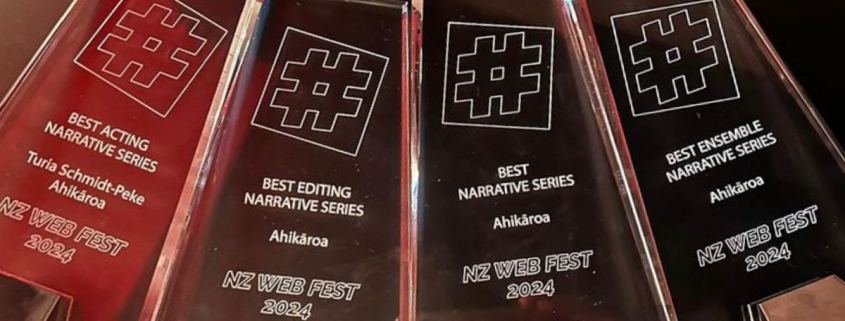
An exciting update from our previous piece about the DEGANZ members nominated for awards at this year’s NZ Web Fest! Six projects with members involved won awards. The Ahikāroa team had a particularly successful run, taking home four awards by the end of the night.

The festival held the awards ceremony in Tāmaki Makaurau on 10 September to wrap up its run this year. Congratulations to the winners and all nominated projects!

NZ Short Films (Narrative)

Dive

Best Writing

Writer: Fredrick Pokai

Director: Tyler Redmond

A coming-of-age drama that follows a young competitive swimmer named Paula, who is trained by her father Troy. Despite her dedication and hard work, Paula’s results don’t meet her father’s high standards. Meanwhile, Troy struggles with financial problems and the possibility of losing their home. As the national swimming competition approaches, tensions rise between father and daughter, and Paula begins to question her passion for the sport.


NZ Web Series (Factual)

Turning the Tide

Best Directing

Director: Magnolia Lowe

Producer: Tui Ruwhiu

Editor: Amanda Mulderry

The Turning the Tide six-part short documentary series highlights the work of researchers, kaitiaki, and community members as they pool their knowledge and resources to improve the health of the seas around Aotearoa New Zealand.


NZ Web Series (Narrative)

ADHD + Me

Best Directing

Director: Michelle Ang

A comedy web series about a woman who unexpectedly receives a late ADHD diagnosis. When her ADHD manifests as a person that only she can see, she must reevaluate how well she knows her own brain.

Ahikāroa

Best Narrative Series

Best Editing

Best Ensemble

Best Acting (awarded to Turia Schmidt-Peke)

Co-editor: Jack Woon

Writer & Storyliner: Onehou Strickland

A Māori bilingual series following a crazy group of city-based rangatahi. They’re young, kura kaupapa raised and dangerously onto it. Their world orbits around getting cash, cutting corners and charging their phones.

The Creature

Best Cinematography

Director: Jake Tabata

Producer: Isabelle (Izzi) Hoskyn

Stuck in the online dating rut of endlessly swiping with no results, Aidan is ecstatic when he matches with his ‘dream man’. However, to leave for his date, Aidan must face the perturbed Creature lurking in the shadows of his home.

Well Well Wellness

Best Writing

Writer: Brady Polkinghorne

Director: Jack Nicol

A comedy web series that follows a silent retreat run by some well-meaning but hopeless wellness gurus. It follows the bumbling owners trying to save their haven, the mystic teachers who aren’t as deep as they seem, and the assorted mix of weird, wonderful, and worrisome retreatants who come to stay, find peace, or otherwise.


Last updated on 21 November 2024