
On Wednesday evening, Associate Minister for Arts, Culture and Heritage, Carmel Sepuloni, together with the Minister for Economic Development, Phil Twyford, and Minister for Broadcasting, Kris Faafoi, announced the Screen Sector Recovery package. Included was $140 million previously announced in the budget, being $115 million to the international NZ Screen Production Grant, with $25 million to the domestic Screen Production Grant for local productions.

The rest of the announcement was new funding, but how much and where it went was clear as mud. As far as I can figure out it breaks down like this:

  • $15.4 million to NZFC with $2 million allocated to cultural capability funding and the rest to recovery for production affected by COVID.
  • In a guess on my part, $8 million to NZ On Air for production affected by COVID.
  • $50 million in a new fund to be dedicated to high-end drama and film projects, targeting streamers it would seem, with criteria still to be developed.
  • An additional $25 million, which seems to have materialised out of nowhere, for NZ On Air to spend over four years for Pacific, student and disability broadcast media.

The elephant in the room, though, is insurance. Without it, no new high-end drama or feature film will be able to get up without a major studio willing to bankroll the whole thing and take the associated risk that COVID has brought.

How to get insurance and completion bonds for production is a global problem putting the brakes on production everywhere. The insurance industry has already been hit with massive COVID-associated claims. Consequently, insurers won’t issue insurance to cover COVID-19.

Screen industries around the world are hatching various plans to deal with the insurance issue, but they all, to a greater or lesser degree, come down to one thing: government underwriting of insurance.

The New Zealand Film Commission commissioned the Screen Production and Development Association (SPADA) to write a paper for Government to outline the issues and justify the call for Government to come up with a solution that would allow new drama and feature film projects to get up. While the new funding announced on Wednesday night was welcomed by everyone, a significant number of those in attendance at the Beehive waited with bated breath for a Government response to the insurance issue. It never came.

Small productions and those that had existing insurance coverage prior to COVID will get made, but independent production everywhere needs the insurance problem solved. That includes any NZ On Air funded drama soon to be announced from the last round. Without an insurance solution or a studio willing to take on the risk, we could all be watching a lot more low-budget short-form web series to satisfy our scripted desires.

Unfortunately, we are still waiting cap in hand for the Government to come to the rescue. If they do, we will then truly be able to take advantage of the very fortunate position we find ourselves in as a screen industry in comparison to the rest of the world.

Here’s hoping.

Tui Ruwhiu
Executive Director
Globalisation has been both beneficial and detrimental to the New Zealand screen industry. Beneficial in that we have been the recipient of international productions coming here and spending many millions of dollars on goods, services and wages with a net benefit to the New Zealand economy.

When American producer Rob Tapert really kicked it off with Hercules in the 90’s, he also trained up many of the crew who went on to work on his other shows and later Peter Jackson’s and Andrew Adamson’s films, amongst other big budget projects. Now our crew have a reputation second to none.

But we really screwed up when we signed up for the General Agreement on Tariffs and Trade and failed to get an exemption as Australia did for audiovisual services.

This exemption allows Australia to impose broadcast quotas for local content. It also creates the possibility for Australia to apply quotas to digital services, including streamers as is now being actively discussed there. Meanwhile, in New Zealand when we talk about quotas on broadcast and levies on streamers, the first thing that springs from peoples’ mouths is, “We can’t because of GATT.”

Well maybe it’s time to drive significant change here as is currently being proposed in many other sectors. The COVID-19 pandemic has brought with it great opportunity to make change that before would never have been imaginable.

We are seeing examples of it every day in the news. The proposed merger of TVNZ and RNZ, the setting aside of the Resource Management Act, the drive to grow the New Zealand manufacturing sector, and the selling of CBD head offices because working from home has become a reality for many. We are now having to reconfigure the rules to adapt to the new normal we find ourselves in.

With America turning in on itself, the idea of unchecked globilisation being reconsidered, and trade deals being mooted for restructuring and renegotiation, now is an ideal time for cultural considerations for local content to be reinstated. We should be looking to ensure that New Zealand content on NZ screens is a requirement, not just a nice to have, whether it’s on local broadcasters and platforms or international streamers swamping us with international content.

In the meantime, we just have to figure out a way to swamp the world with New Zealand content. Some more funding for NZ On Air and the NZ Film Commission would be a good start.


Tui Ruwhiu
Executive Director

Zoom's Gallery Views of DEGNZ's workshops

As life accelerates back to speed, for some, lockdown may seem like a distant memory. What happened in the DEGNZ calendar during April and May, you ask?

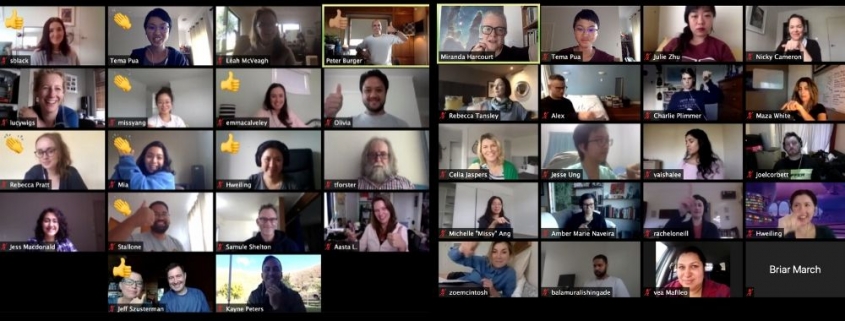
Lockdown turned out to be the perfect opportunity for us to test online learning, starting with part two of the Directors Toolkit with Peter Burger after the original weekend got cut short pre-Lockdown. It was great to bring the class of directors back together for further teaching, and to lay off the hand sanitiser.

Acting/directing coach Miranda Harcourt also ran two excellent Directing Actors sessions for the Guild. We received so many applications that it was a real blessing that we could stretch the one workshop to two – thanks in part to Miranda’s normally chocker schedule being grounded. Even then, we sadly couldn’t give every applicant a place.

Zoom's Gallery Views of DEGNZ's workshops

Grids within a grid: Participants in workshops with Peter Burger and Miranda Harcourt.

During lockdown, we enjoyed seeing what members made as part of DEGNZ Play, a creative outlet for members to make and share 1-minute videos from inside their bubbles.

Round 1 of the 2020 Table Reads, in association with the NZ Writers Guild, went virtual via Zoom. A cast of seven actors read and contributed their thoughts on a feature film script being written by Nick Ward and directed by Kath Akuhata-Brown (DEGNZ), the lucky draw winners. We’ve got two more rounds this year, likely around a 3-dimensional table. If you’re writing a feature, these are a great opportunity and exclusive to members only.

DEGNZ also scrutinised a bunch of how-to guides and took events online. If you missed any of our live events, you can watch the recordings for Young Creators: Think Outside the Box, Screenlink: The Editor, a Composer’s Friend or Foe? and DEGNZ Forum: Draft Screen Sector Strategy 2030 Panel Discussion, which were held on our Facebook Live.

Now, looking ahead, we’ll be picking up the workshops that are near impossible to adapt for online – our practical actor-director workshops and a new and improved Assistant Editors Course. Our first in-person workshop is on this Friday with the seven directors of the 2020 Women Filmmakers Incubator. Meanwhile, Melbourne-based Kiwi director Jonathan Brough prepares to teach Comedy Directing online in June.

Based on feedback we received from participants, we feel online learning went pretty well. We are interested in developing our professional development programme to provide a mix of in-person and online opportunities in the future, so that more directors and editors can benefit and come together from across New Zealand.

So thanks to learning with us.

Tema Pua
Events & Marketing Manager

When you look at the problems besetting the world, with amongst other things COVID-19 still rampant in many countries, the U.S. a powder keg ready to explode and war raging on a number of fronts, it’s hard not to look at little ole New Zealand, steal the Aussie phrase and say, we’re The Lucky Country. And in comparison to Australia’s, we have to say we’re the lucky screen industry.

No matter what your political persuasion, the New Zealand screen sector has been blessed with a prime minister who is also the Minister for Arts, Culture and Heritage. In Australia, Scott Morrison’s government abolished the Arts Department (our MCH) in December 2019 and merged it with Transport, Infrastructure and Regional Development.

The Federal Government over there has resisted calls for a nation-wide industry stimulus package. In New Zealand, meanwhile, the response to COVID has been:

  • $7.9 million for Careers Support for Creative Jobseekers
  • $70 million over three years for a Creative Arts Recovery and Employment Fund
  • $60 million over three years for a Cultural Innovation Fund
  • $20 million for a Cultural Capability Fund
  • $16.5 million for a New Zealand Music Recovery Fund
  • $16.5 million top up for New Zealand On Air

All this is in addition to other funding for the Culture and Heritage sector announced in the budget. And we are all waiting with bated breath for a stimulus package that will have funding specifically for the screen sector.

When it comes to screen workers, a high percentage of workers here quickly received the wage subsidy. In Oz, the response was slow and according to a just released Australian Directors Guild survey, nearly 50% of their members do not qualify for the Australian Government’s Job Keeper (Wage Subsidy) or Job Seeker (Unemployment Benefit).

Fingers crossed we have at least contained if not eliminated the Coronavirus. This has allowed our domestic soap, small crew projects and this week, our first film back into production. We have 56 international personnel allowed into the country through a special immigration channel, under managed quarantine at Wellington’s Museum Hotel and ready to kick start Avatar back into life and kick off another still-secret film.

With other international projects also likely to start shortly and NZ On Air expected to fund a considerable amount of drama from the recent round, we could well find ourselves back in the situation we were in at the beginning of the year with a dearth of experienced crew and international productions poaching crew off each other with offers of higher rates. Without a Trans-Tasman bubble in place, we certainly won’t be bringing crew in to fill the high demand here as was happening before.

Australia is also getting ready to swing back into production with their Health & Safety Standard & Protocols just released. However, they are faced with a continued blanket suspension of commercial free-to-air content quotas, which their producers’ organisation, SPA, feels smothers commissioning demand at a time when their industry needs it more than ever.

At the Guild, we are feeling lucky too, as we rapidly return to the new normal. Across the last two months we have been running a considerable number of Zoom and or Facebook Live workshops and sessions because of COVID. But this Friday we are holding our first in-person session with the first of five DEGNZ Emerging Women Filmmakers Incubator workshops for 2020. We do though need your continued support because as an organisation we haven’t escaped unscathed, understandably, with financial membership down because of the pandemic.

With domestic tourism now key to our tourism sector’s survival and location production an important contributor to transport, food and accommodation providers, we have an opportunity to help out and at the same time see how lucky a country we really are.

Tui Ruwhiu
Executive Director

Just when you thought we were all stuck in our ways, along came COVID-19. Now changes are flowing thick and fast to adapt to the brave new world this deadly virus has inflicted upon us.

The Resource Management Act is being given the flick to allow for shovel-ready infrastructure projects. Tourism operators are now having to give a toss about Kiwi tourists. (I’m surprised nobody has questioned yet whether we really want all those international tourists to return and put the strain back onto our environment and infrastructure.) The Australian and New Zealand governments are figuring out how to hold hands and sing kumbaya in a Trans-Tasman bubble. We might even have a new National Party leader by the end of the week.

Just look at the changes the NZ screen sector has gone through in two months. We have temporary Terms of Trade at NZFC that say, amongst other things, goodbye to the NZ theatrical distribution requirement and hello to a VOD platform. TVNZ is commissioning Maori and Pacific genre drama with its supernatural anthology RFP. Domestic production has all of a sudden become vitally important to crew.

South Pacific Pictures took the bit between its teeth and developed its own COVID Health & Safety (H&S) protocols signed off by WorkSafe to allow Shortland Street to get back up. We now have the WorkSafe-approved COVID Protocols and Standard thanks to the hard work of individuals from the Screen Industry Guild of Aotearoa (Techos), the NZ Advertising Producers Group and a number of others.

And the draft Screen Sector Strategy unleashed on us during the lockdown? Well after further ‘feedback’ it’s going through some additional ch-ch-changes as well.

But what’s happening out there in the big wide screen world? Iceland, South Korea and Sweden are already in production, with Iceland unveiling details on how international productions can get back up and running there with a special immigration channel and quarantine rules. Some Eastern European countries, which get a lot of US and UK runaway projects, are restarting with the Czech Republic and Poland leading the way.

The UK government is allowing film and TV production to restart. A coalition of Britain’s top platforms have published a guide for TV production, while The UK’s new protocols for film and high-end drama are expected at the end of May. In the US, though, production is still at a standstill. Directors Guild of America board member and Contagion director Steven Soderbergh has been put in charge of the guild’s efforts to address COVID. According to an article in the LA Times, it’s the guilds and the unions that will determine when production will start there.

Across the ditch, Neighbours is up and running and Wentworth is supposedly about to restart. The guilds there have been working hard on their COVID-19 H&S protocols and expect government sign off on them shortly.

Thankfully, Level 2 is allowing production in film and TV here to get going, so we’re in a good place. But there’s much further to go, and more changes that need to occur before we can have the New Zealand screen industry humming again. Each one of us has a part to play in making this happen, whether it’s helping to effect the changes necessary, or just washing our hands, maintaining social distance and staying home when sick.

As we head into this next phase of life under COVID, stay safe, stay well and remember you can call on us here at DEGNZ at any time. We will do our best to help you out.

Tui Ruwhiu
Executive Director