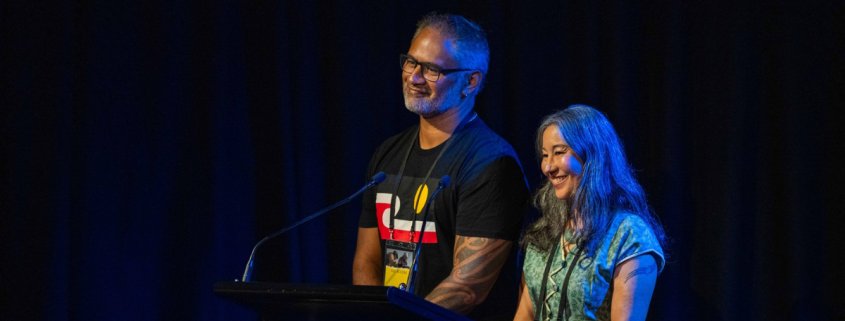
DEGANZ members Mike Jonathan and Kim Webby have had some exciting news for their in-the-works cinematic feature documentary, Unlikely Kin.

The duo recently attended the Australian International Documentary Conference (AIDC) with the project, which was selected for the FACTory Rough Cut Showcase.

They also received NZFC’s Feature Film Finishing Grant to fund the last stages of post-production.

Co-directed by Mike and Kim, the feature doco focuses on themes of environmental and social justice. It is accompanied by their docu-series, Whales, Rats & Kauri, which is also in the final stages of post-production.

We look forward to seeing both Unlikely Kin and Whales, Rats & Kauri when they are out in the world!


Congratulations to DEGANZ member Liv McClymont for being selected for the 2026 Show Me Shorts Short Film Lab!

The Short Film Lab is a development programme designed to support emerging storytellers as they shape and strengthen their next short film. Over the coming months, Liv and the other selected filmmakers will workshop their projects with mentors and collaborators. At the end of the Lab, two projects will be selected to receive production funding to bring their short films to life.

Liv has been building her portfolio over the past few years with documentaries I Stand for Consent and The Man Outside, and dramedy web series The Sender. She has also been working in the commercial space, directing the 2degrees campaign NOtifications to promote digital well-being and Qantas’ Just the Two of Us ad to highlight flights over the Tasman as a way to connect Kiwis and Aussies.

We look forward to seeing what she develops in the Lab!


This week’s DEGANZ Watch List features stories packed with chaotic characters.

First up is the new drama series Crackhead, directed by Emmet Skilton (DEGANZ). You can watch the first four episodes on ThreeNow.

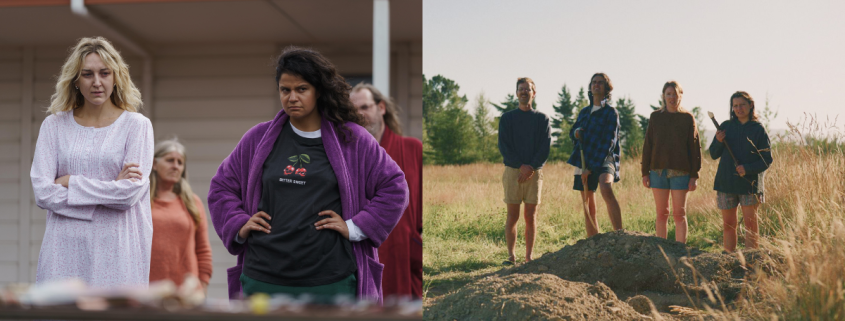
Ahead of its wider theatrical release, the trailer for fellow member Callum Devlin’s feature The Weed Eaters has just dropped. In the lead-up to its nationwide premiere on 30 April, the film’s creative team are hosting a series of Q&A screenings across Aotearoa. You can find screenings near you on Flicks.

Chaos ensues below…

Crackhead

Drama Series

Director: Emmet Skilton

Drug-addicted party-animal Frankie has blown it all up – her inheritance, her relationships, and most recently, her sister’s house. It’s time to go to rehab.


The Weed Eaters

Drama Feature

Director: Callum Devlin

When Jules joins her new boyfriend on a New Year’s Eve getaway with his old high school mates, she’s looking to get some peace and quiet, smoke a bit of weed, and make some new friends. But when the holidaymakers stumble across their host’s long-forgotten stash of ancient weed, things quickly take a turn for the nightmarish.


DEGANZ member Leanne Pooley‘s four-part docuseries Choir Games has been selected to screen at SeriesFest in May.

Often referred to as the ‘Sundance of TV’ with series like Yellowstone and Mr Robot launching there, SeriesFest is considered one of the top television festivals in the U.S.

This year, Choir Games is one of just eight unscripted programmes in competition. The festival describes the selected documentaries and limited series as projects that “bring real stories to life, celebrating the power of unscripted storytelling that informs, inspires, and captivates audiences.”

Leanne will be travelling to Denver, Colorado, for the festival.

If you still haven’t seen it, Choir Games is available on Neon and Sky Go in Aotearoa now.


View from the Top banner

I remember the first director’s training session for TV I attended now many years ago. Our workshop facilitator, John Harris, who went on to establish production company Greenstone, told us that one way to think of directing was like shopping: we had a shopping basket, and we had to fill it up for the editor with the right ingredients. A simple metaphor, but it worked for me at the time.

More importantly, I believe, it highlighted the importance of the editor to the creative process of crafting a story for the screen.

Editors too often are undervalued for the work they do. It’s not just about pushing buttons. It’s about utilising their creativity, knowledge and skill to elevate the material they’ve been given, which sometimes can be less than ideal.

An editor can save a director’s bacon, and often does, in factual and in narrative.

Like directing, editing is both an art and a craft. It’s one of the reasons that DEGANZ has established the Aotearoa New Zealand Screen Editor accreditation. To give the art and craft of editing its proper due when executed at a consistently high standard.

Unfortunately, editing and assistant editing can suffer from a lack of respect in the production process, especially when budgets are tight. This is unfortunate because it’s a false economy to seek to skimp in these areas and can ultimately mean budget and time are wasted, to the detriment of the project.

Another major area of concern for the Guild is the replacement of editors, particularly on feature films. Yes, failing relationships between director and editor can sometimes necessitate a change in direction. But the editor can sometimes bear the brunt of failure in other areas or because of external pressure exerted from distributors and sales agents on directors, producers and executive producers. Would a director or other HOD be replaced so easily? Of course not.

There are significant negative health and wellbeing outcomes that manifest for editors when they are replaced, particularly when it is handled poorly, as is often the case.

Equally concerning is the replacement or marginalisation of the assistant editor role. Working editors will all attest to the vital importance of this mahi and the detrimental effect on effective, efficient, quality post-production from losing assistants to ‘combo deal’ approaches from post houses, or the failure of producers to allow for, or enough time for, assistant editors to do the vital work they do.

DEGANZ also does not support the practice of multiple editors being contracted to work on a feature film. There can certainly be a need to bring in an outside editor consultant at times, to help the director and editor team look at the project with a fresh set of eyes. The hiring of multiple editors to execute a film, though, is a sausage-factory approach to the cinematic, artistic endeavour that does not recognise nor value the director-editor creative collaboration appropriately.

The DEGANZ board is now looking at how to best address these issues and is liaising with international editor bodies, examining best  practices, as well as engaging with local practitioners and entities to see what learnings and ideas we could utilise to effectively achieve outcomes that will benefit individuals and projects.

Editing is an art and craft that can make or break a project, and it deserves to be recognised for the crucial part it plays in the production process.


Tui Ruwhiu
Executive Director