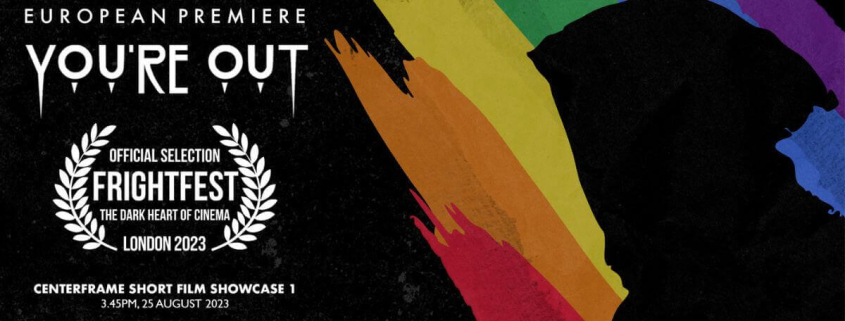
DEGANZ member Chaz Harris‘ latest short film, You’re Out, is having its European premiere as one of the 13 international short films in the 2023 FrightFest in London. It will screen in the Centreframe Short Film Showcase #1 at the Cineworld Leicester Square. This exciting news follows the film’s recent semi-finalist success at the Flickers’ Rhode Island International Film Festival in the US.

In You’re Out, a masked assailant torments a closeted gay man, threatening to out him. Chaz was the writer, director, and producer on the project, which was the first production made through his Wellington-based production company Prosean Pictures.

The film will fit in well with the other genre pieces at FrightFest. The festival is one of the world’s largest horror and fantasy film festivals, bringing genre filmmakers and fans together to celebrate the weird and wonderful.

The festival’s co-director Alan Jones commented,

[FrightFest is about showing] that the most unexpected and delightful discoveries happen when wide-ranging topics, different people, and varied cultures come together in horror harmony. FrightFesters will experience an amazing variety of films, in an eclectic line-up which serves as a powerful tool of democracy, activism, diversity, inclusivity and social awareness.

The festival has featured many big-name horror films and directors over the years, including the UK Premiere of Guillermo Del Toro’s Pan’s Labyrinth. The world-renowned director has since dubbed the festival the ‘Woodstock of gore.’

Check out the trailer for You’re Out here.

Last updated on 17 August 2023

View from the Top banner

For those of us in the industry we can’t help but be aware of the writers’ and actors’ strikes in the US, not only because of the impact it’s having on international productions coming into New Zealand but also because of the issues being raised, particularly when they relate to having a sustainable career.

Of the 160,000 SAG-AFTRA members on strike for three weeks now, only 10 percent of them are the actors you see working the red carpets and earning massive fees for their performances. 86 percent of their membership (136,600 members) don’t earn the US$26,000 per year required to qualify them for the guild’s health insurance. In 2022, the US Bureau of Statistics reported that the average pay for an actor in California was US$27.73/hr.

In the gig economy of the screen industry in the US where most screen workers are considered independent contractors, the residual* payments that actors used to receive prior to streaming could help them to ride through the choppy waters of no paid acting work between jobs. There’s an article showing supposedly successful actors on highly successful streaming shows and the residuals they received—cents, or sometimes a few dollars. See it here.

The 11,000 WGA members are coming up to 90 days on strike. Like SAG members, WGA members have base minimums that they cannot be paid below for the work they do. The WGA also negotiated residuals for their members. However, over time and particularly with the advent of streaming, what the majority of writers have been paid has dropped towards or onto the minimums, which were negotiated three years ago. At the same time, streaming has continued to grow and the residuals from streaming are measly, unlike what used to be earned as residuals from broadcast, cable, etc. The studios are also trying to use fewer writers to do the work required, amongst a number of other issues for the WGA.

Both guilds are also concerned about how the studios will use Artificial Intelligence to replace humans in the execution of writing and acting work.

The Directors Guild of America was able to reach a settlement that addressed their issues with streamer residuals and AI, and other claims—The reason they aren’t on strike with the writers and actors.

Sitting here in li’l ol’ New Zealand, we can only marvel at the fact that these US guilds have collective agreements in place that offer base minimums, healthcare, superannuation, and residuals amongst other benefits.

Of course, New Zealand is different from the US. We have a public health service (no matter that it’s getting worse by the year). We have accident compensation (ACC). We have a government retirement scheme, which we call ‘super’ or ‘the pension’. And we have Kiwisaver.

But if we look a little closer to home to Australia, where screen workers are generally treated like employees rather than contractors—because most screen workers don’t have the freedom of executing their work how and when they want to—we can see that ‘Fringes’, i.e. holiday pay, superannuation (our Kiwisaver), and workers compensation (our ACC) are built into production budgets and paid accordingly by the production company.

In New Zealand in the screen industry, pretty much everybody is an independent contractor, even though you are required to turn up at specific times, on specific days, just as employees are required to do.

You, the independent contractor, are required to pay your own taxes, ACC, Kiwisaver, and GST if applicable.
You have no base minimums, meaning you can be paid less than the minimum wage set for employees.

Most below-the-line crew get paid overtime, which stops their pay going below the minimum wage. That’s not the case for writers, directors (and producers), who often do unpaid or low-rate work to create the shows that crew then get hired to work on. This contributes to driving their pay rates below the minimum wage. Take a look at the just released WIFTNZ Screen Industry Gender Pay Survey here. It states that according to the census, approximately 40% of women and 28% of men in the screen industry earn less than the minimum wage.

While crew get to work on international projects where they can charge higher rates and still get their overtime payments if required to work it, it’s almost impossible for NZ above-the-liners to get onto them, apart from actors who might be able to secure supporting or minor roles—domestic production is pretty much all there is.

In New Zealand at this point, there is no established residual system that allows above-the-line creatives to earn some income from their work beyond their fees, to help get them through those times of no or unpaid work. There is, though, a mechanism for producers to gain potential additional income through being gifted equity in a production, either from the NZFC through the ‘producer corridor’ for non-NZ Screen Production Rebate (formerly NZSPG) projects, or through the 40% producer equity gifted to the producer for NZ Screen Production Rebate projects. It’s at the discretion of the producer as to whether or not they will share this equity with anybody else.

Which brings me to the Screen Industry Workers Act, of course. It’s the means by which the guilds and unions in New Zealand hope to address the pay rates, terms, and conditions for New Zealand screen workers to help them have sustainable careers—Something the US guilds have sought and continue to do for their members through decades of negotiation and collective agreements.

We at DEGANZ are preparing for our first negotiation of a collective agreement, which is likely to take place in the first half of 2024.

You can see from the picket lines of SAG-AFTRA and the WGA a visible expression of “it’s better together” not only with each guild’s members supporting their guild but with the separate guilds supporting each other.

We are going to need all your support in the preparation and negotiation ahead. So get behind us and the other guilds, too, to make it better for everyone.

*Residuals are long-term payments to those who worked on films and television shows, negotiated by unions, for reruns and other airings after the initial release.

Tui Ruwhiu
Executive Director

Last updated on 3 August 2023

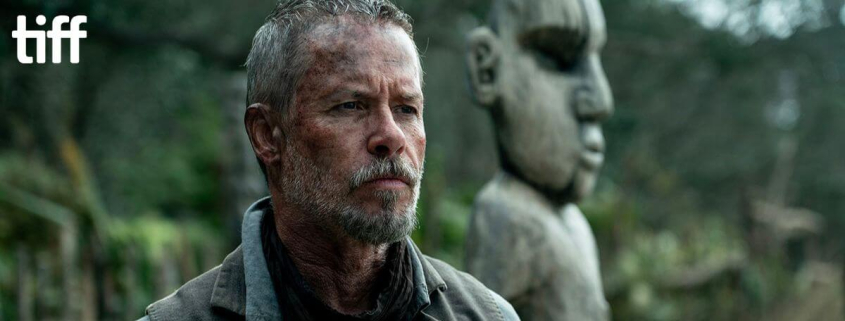
The Convert, edited by DEGANZ member Luke Haigh, is premiering at the Toronto International Film Festival (TIFF) in September.

The New Zealand-Australia production stars Guy Pearce as Thomas Munro, a lay preacher ministering to a British settlement in 1830s Aotearoa. His violent past as a soldier is questioned, and his faith is put to the test as he finds himself caught in a long-standing battle between two Māori iwi.

The action-filled historical epic will screen as a special presentation at TIFF alongside some of this year’s biggest films, including the Cannes Palme d’Or winner and NZIFF opener Anatomy of a Fall. TIFF describes these special presentations as high-profile premieres from the world’s leading filmmakers.

TIFF is a not-for-profit cultural organisation dedicated to creating transformational experiences for film lovers and creators of all ages and backgrounds. Since its founding in 1976, the festival has become one of the world’s largest and most prestigious international film festivals.

Congratulations to Luke and the team for the international premiere!

Last updated on 3 August 2023

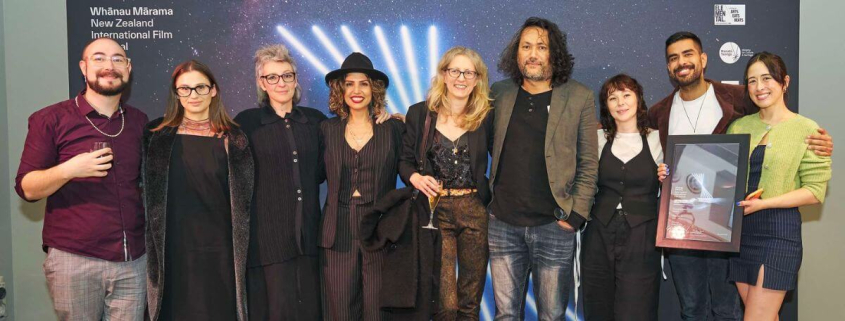
Congratulations to the winners of NZIFF’s NZ’s Best 2023 awards, including DEGANZ members Pulkit Arora and Jaimee Poipoi! After the six finalist films premiered, the jury (including DEGANZ member Peter Roberts) announced the winners.

For Anu, Pulkit won the Creative New Zealand Emerging Talent award with a $4,000 cash prize. The jury commented:

Writer-director Pulkit Arora has crafted a soulful and sensitively-wrought portrait of a woman literally and figuratively isolated in her grief. Movingly uncovering the oft-dismissed residual pain of the pandemic era, Anu discovers the cinematic hidden within the drab of an anonymous quarantine hotel. Aided by an exquisite lead performance from Prabha Ravi, Arora firmly announces himself as a fresh talent to watch.

Hey Brainy Man, co-produced by Jaimee, won the $7,500 NZIFF Patrons Award for Best Short Film. The jury’s comments were:

Formally daring, bitterly humorous and dreamily unsettling, Hey Brainy Man is a heady alchemical mix of absurdist flourishes and clearheaded warnings about humankind’s hubris. Backed by an endearingly batty chorus of Neanderthals, directors Randerson and Taylor are clear in their messaging, sounding the alarm without ever succumbing to overt or obvious preachiness. The film’s final note is one of dreadsoaked foreboding, lingering in the mind long after it’s subjects have faded into the ether.

Additionally, DOP Adam Luxton, who worked on both Anu and Hey Brainy Man, received a special mention for his cinematography.

The Audience Award, voted for by the public, will be given on the closing night of the festival in Wellington. The winner will receive 25% of box office sales from NZIFF screenings in Auckland, Wellington, Christchurch, and Dunedin. Non-Auckland festival goers, make sure you get to NZ’s Best and vote for your favourite film of the bunch!

Well done to the award winners and their fellow finalists! We are already excited to see next year’s selection.

Last updated on 3 August 2023

NZFC announced the funding decisions for new productions to come, featuring many DEGANZ members on new and existing productions.

Extended Screen Production Recovery Fund

Boy Eats God

Short Film; $8,250

Writer/Director: Litia Tuiburelevu

Moving Houses Series 2

Series Doc; $71,094

Directors: Roz Mason, Emily Qereqeretabua

Feature Film Finishing Grant

These films received funding in time to screen during NZIFF this year.

The Paragon

$59,500

Writer/Director/Producer: Michael Duignan

Red Mole: A Romance

$58,900

Writer/Director/Producer: Annie Goldson

Grant Sheehan: Light, Ghosts & Dreams

$57,442

Writer/Director/Producer: Robin Greenberg

Early Development & Documentary Development Funding

Elephant Kisses

Drama; $25,000

Director: Rouzie Hassanova

Sisters Jess and Rosa take their beloved dog Maxx on a quest to find the magical elephant Mythra that can cure animals, but to succeed they need the help of best friends Denny and Natalie.

Pati(wt)

Documentary; $20,000

Producer/Director: Rebecca Tansley

The story of how two Samoan brothers sang their way from South Auckland to the world’s greatest opera stages – and into audiences’ hearts.

Te Puhi

Drama; $10,000

Writer/Director: Cian Elise-White

Aotearoa, New Zealand 1962. Te Puhi (18) is crowned Miss New Zealand claiming international fame overnight for being the first Māori to do so. Torn between whānau and dreams of winning the Miss World title in London, Te Puhi goes on a journey of self-discovery and love.

The Lie of the Land

Drama; $25,000

Director: Caroline Bell Booth

In the isolated and unforgiving high country of Otago, two dutiful farmer’s wives break free from the life expected of them, when they risk everything to be together.


Congrats to all funding recipients; we look forward to seeing these projects progress!

Last updated on 3 August 2023