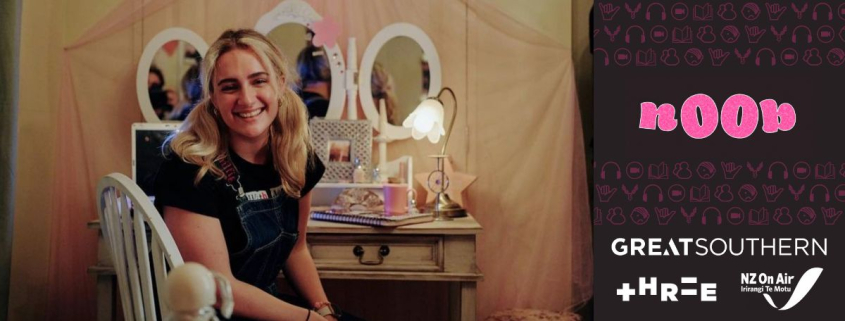
Popular TikTok series n00b, co-created and directed by DEGANZ member Victoria Boult (Incubator 2023), is heading to ThreeNow and Three as a new comedy series. According to the NZ on Air media release, Great Southern Television has received up to $1,499,541 to bring the series to fruition.
The show originated on the short form video social media via the Every Voice initiative between NZ on Air, Screen Australia, and TikTok. Since its release in August 2022, it has garnered over 1.5 million TikTok views across its twelve parts.
The anthology series follows teens in Aotearoa in the early 2000s as they venture into the unknown territories of sex, relationships, and the internet. Each episode is chock full of the decade’s iconic aesthetics and harks back to online video chat rooms, making mixtapes, and embracing your inner emo.
The TV series will differ slightly, following a group of adolescent outcasts in small-town New Zealand as they attempt to cope with life through the internet and its newly invented social media.
Congrats Victoria! We can’t wait to see how the show evolves and grows.
http://degnz.sensedesign.co.nz/wp-content/uploads/2023/06/n00b-series.jpg4561200admin/wp-content/uploads/2021/10/DEGANZ_logo_home.pngadmin2023-06-06 14:06:122023-06-08 17:46:09More ‘n00b’ to Come
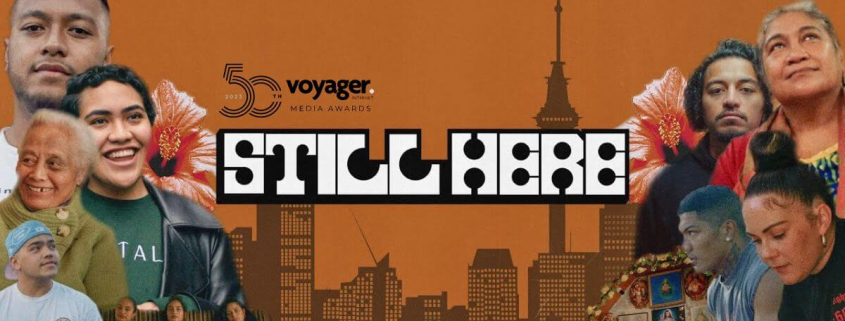
The Voyager Media Awards has announced the 2023 winners with Still Here taking home the Best Video Documentary Series title. Congratulations to DEGANZ members Josh Yong and Frangipani Foulks who are credited as editor and assistant editor respectively. Josh was also the series’ associate producer.
Still Heretells stories of Pasifika communities residing in Auckland’s Ponsonby, Herne Bay, and Grey Lynn suburbs. The four-episode documentary series captures the families’ lifestyles that keep their traditions alive. By remaining in their family houses, they fight rampant gentrification daily. In each episode, the intergenerational community stories debunk the myth that ‘all the islanders have left.’ They are still here and visible.
As the judges of the awards said,
These intimate portraits (of the locals) are a rich intersection of the past and present that conveys with nuance what it means to be Pacifica in New Zealand.
The Voyager Media Awards acknowledges the best of New Zealand’s journalism. The awards, formally known as the Qantas Press Awards and the Canon Media Awards, aim to celebrate the work of journalists, reporters, feature writers, columnists, cartoonists, reviewers, photographers and video journalists.
http://degnz.sensedesign.co.nz/wp-content/uploads/2023/06/WEBSITE-Featured-Image-2-1.jpg4561200admin/wp-content/uploads/2021/10/DEGANZ_logo_home.pngadmin2023-06-06 11:09:382023-06-08 17:47:25‘Still Here’ at the 2023 Voyager Media Awards
DEGANZ members Sophie Black, James Fink-Jensen, Eva Fulco, and Brian Gill have been nominated at this year’s Vision Feast 2023.
Vision Feast is an annual short film and music video festival that acknowledges filmmakers with a creative passion, technical skills, and what they call a ‘stroke of madness’. The festival accepts both domestic and international submissions. This year’s international entries are from the USA, Japan, Australia, South Korea, Canada, and Europe.
Vision Feast nominated Sophie’s project Believing is Seeingin two categories – Best Aotearoa Project and Best Documentary. The short film features Dr Robert Bartholomew who debunks myths about ‘psychogenic illness’, a stress response caused by social media.
Strangers, a short directed by James, is nominated for the Emerging NZ Filmmaking Talent. The film explores the struggles of a young and awkward journalist to make a lasting impression on a first date. Despite hopes of a romantic cafe date, it unavoidably all goes wrong. From the unconfident protagonist to the impatient waitress, all the characters undergo an emotional roller coaster ride in just 5 minutes.
Brian’s short film Solitaire and Eva’s Buona Notte, Mio Amore are in the Best New Zealand Student Work category. Solitaire is about a lonely security guard who plays a card game only to witness the cards come alive to keep him company. Meanwhile, Buona Notte, Mio Amore explores a romance during World War II.
You can grab seats for the festival’s evening screening at Academy Cinemas in Auckland now. Congrats to the selected filmmakers!
http://degnz.sensedesign.co.nz/wp-content/uploads/2023/05/WEBSITE-Featured-Image-1-1.jpg4561200admin/wp-content/uploads/2021/10/DEGANZ_logo_home.pngadmin2023-06-06 11:09:102023-06-08 17:51:46Feast Your Eyes on DEGANZ Members at Vision Feast 2023
When I was in primary school, I never knew I was Māori, or should I say I never understood what being Māori was. I always thought I was a little bit darker than a lot of the other kids, but that was ok. I was introduced to te reo Māori and kapa haka at primary school, and I felt like a gap was being filled. I carried on learning te reo Māori and doing kapa haka at college.
From a young age, I always thought I would be a teacher because I had some cool teachers, and I just thought I wanted to be like them when I grew up. Then in my senior years at Kapiti College, that changed as I found a love for Māori performing arts. Nearing my final year at college, I came across a one-year course in Film and Television at Whitireia Polytechnic in Porirua. What really caught my eye was that it incorporated Māori culture, and I thought if I didn’t like Film and Television, I could always go and do the Māori performing arts course. That one-year course set me on a path that changed my life, with a job offer in Auckland.
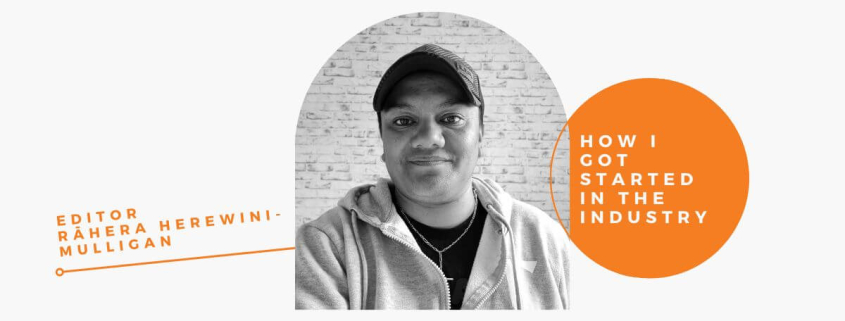
At just 19 years old, I made the move to the big smoke, with no immediate family residing in Auckland. It was 1999, and my editing career had begun as an assistant editor on a new te reo Māori kids show known then as Tumeke. After one season, this was renamed Pūkana and is still in production today. I was fortunate to work with and learn from Francis Glenday, who taught me processes and structure, which I added to my editing foundations and still use and live by today.
After just five months of being on the job, Francis fell ill, and I was asked if I would step up from assistant editor to editor. I must admit I was freaking out and had major doubts that I really wasn’t ready to step up. My director at the time, Hira Henderson, pulled me aside and said, “We will do this together,” and that gave me comfort that support would be there for me. So I asked myself, “Do you want to sink or swim?” and decided to swim.
That decision threw me into the longest week of my life as I worked as the show’s, now, only editor. But with the awesome support from my colleagues, I survived to tell the story and complete my first solo episode edit ever. And I was buggered! I continued work on the show into its 3rd series before moving on to TVNZ, where I would edit shows like Waka Huia, Marae, Mai Time, and Tagata Pasifika. This extended my editing knowledge base and introduced me to more Māori within the industry. After two years at TVNZ, I ventured out into the freelance world and haven’t looked back.
Sneak peeks into the Mokomoko Media editing suite, Rāhera’s editing team with her wife, Janice / Photos: @mokomokomedia
That’s my humble beginnings as an editor. Back then, I never realised I was part of a small group of Māori editors and an even smaller group that could kōrero Māori, which today I hope to help grow even more. I have worked with and alongside some of the best Māori in the Film and Television industry and am forever grateful for their teachings. One being we are a community that does this together.
‘Ehara taku toa i te toa takatini engari he toa takatini.’ My strength is not as an individual but as a collective.
About Rāhera Herewini-Mulligan
Rāhera is a field director and editor who is a fluent speaker of te reo Māori with 20+ years of experience in the television industry. As an editor, she has a wealth of experience across documentary, reality, children, and magazine-style genres from Police Ten 7 (TVNZ) to Moving Out with Kanoa (Three) and many shows for Māori Television. She is also passionate about Kapa haka and is an event/stage manager for Primary School, Secondary School (ASB Polyfest), and Senior Kapa Haka competitions across Tāmaki Makaurau.
How I Got Started in the Industry is a guest blog series from the Directors and Editors Guild of Aotearoa New Zealand (DEGANZ). Our members reflect on how they made their way into assistant editing, editing, and directing—with no two stories the same. They offer advice for those starting out. Get in touch with admin@deganz.co.nz if you’re a member and would like to share your story.
http://degnz.sensedesign.co.nz/wp-content/uploads/2023/05/HIGS-Rahera-Herewini-Mulligan-comp.jpg6751200admin/wp-content/uploads/2021/10/DEGANZ_logo_home.pngadmin2023-05-25 14:00:202023-05-25 15:19:37Editor Rāhera Herewini-Mulligan: How I Got Started in the Industry
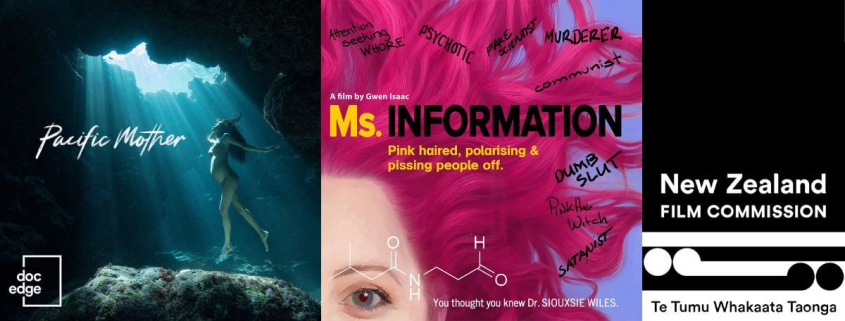
Earlier this month, The New Zealand Film Commission released its May funding decisions. Congratulations to DEGANZ members Gwen Isaac and Katherine McRae, whose projects were two of the three applications successful in receiving the Feature Film Finishing Grant.
Ms. Information, a documentary feature directed by Gwen, focuses on polarising microbiologist Siouxsie Wiles. The pink-haired scientist stepped into the media spotlight during the coronavirus outbreak in New Zealand, resulting in the public’s mixed responses. For production, the crew followed Siouxsie for the two consecutive years of her public service. It reveals what women in power are forced to deal with and challenges the viewer’s perception of misinformation. As the film’s logline says, “Being a woman, expert, and leader can be a dangerous formula in dangerous times.”
Katherine’s Pacific Motherexplores what choices women have when giving birth. The documentary follows the free-driver Sachiko Fukumoto as she navigates the impersonal default systems of maternity. In her search for alternatives, she reconnects with mothers across the Pacific to reclaim traditional birthing knowledge. It will screen at this year’s DocEdge festival in Auckland on 3 June and in Wellington on 8 June.
http://degnz.sensedesign.co.nz/wp-content/uploads/2023/05/NZFC-funding.jpg4561200admin/wp-content/uploads/2021/10/DEGANZ_logo_home.pngadmin2023-05-25 13:16:532023-05-25 16:04:01NZFC Funds Documentaries about Women, by Women