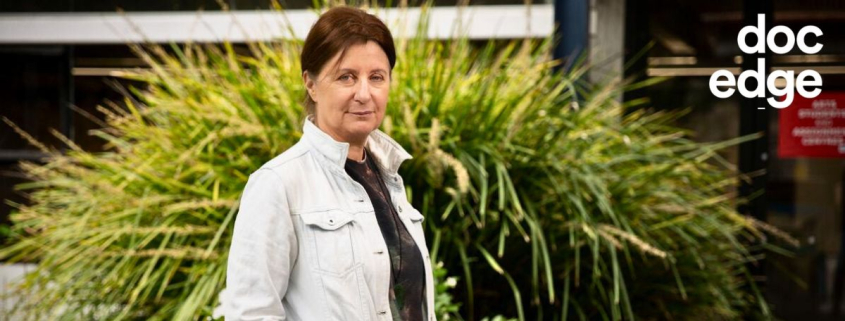
DEGANZ member Annie Goldson has been chosen as this year’s Doc Edge ‘Superhero’. The ‘Documentary Superhero’ is a yearly title honouring those who contributed significantly to the industry. 

Festival director Alex Lee comments that the ‘superhero’ inspires others in the industry and works hard to achieve excellence. He adds, “Annie’s work is exemplary in its authenticity and humanity and shows New Zealand filmmakers the way to tell and the importance of universal storytelling. They are called not by the fame or the fortune but rather are driven by the necessity to bring these stories to the world.”

Annie directed over 12 films and is best known for Punitive Damage, Georgie Girl, Brother Number One, Kim Dotcom: Caught in the Web, and A Mild Touch of Cancer. Her latest film Red Mole: A Romance is in post-production. 

In her interview with the University of Auckland, Annie discussed how honoured she feels and what to look out for in the festival. When asked about her film recommendations from this year’s programme, she mentioned her teaching career at the University. She says the festival is so broad and rich that some would be perfect for teaching in her courses.

She made her selection of both national and international films:

Congratulations, Annie!

Last updated on 25 May 2023

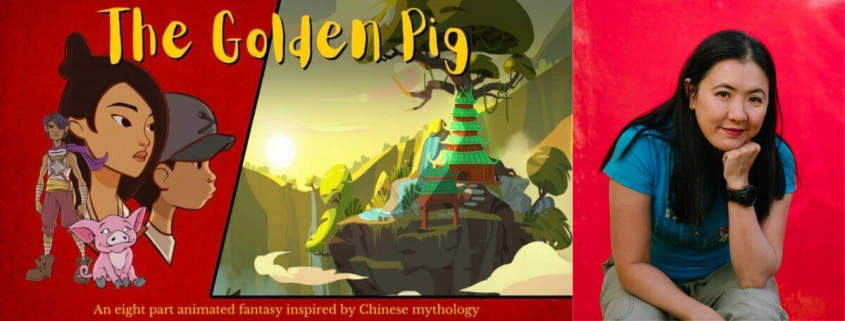
The International Federation of Film Producers Association (FIAPF) and Women in Animation (WIA) have selected DEGANZ member, Hweiling Ow (2021 Incubator), to participate in the second edition of the Stories x Women program for her new animated project, The Golden Pig.

The program works to increase diversity within animation globally, providing support and international opportunities for women animators from emerging film and animation communities from Africa, Latin America, and the Asia-Pacific. FIAPF and WIA are particularly interested in uplifting creatives who want to tell authentic and unique stories.

Sponsored by the Walt Disney Company with additional support from Sony Pictures Entertainment, participants will receive mentorship and one-on-one coaching sessions from internationally acclaimed animation experts. The course will prepare the delegates to pitch their project at the Annecy International Animation Festival and Market (MIFA) later this year.

This selection follows the release of Hweiling’s 3D animated short, Cheng Beng, earlier this year. The short was made as part of the Unreal Engine Short Film Challenge in 2022.

Congratulations to Hweiling on the exciting opportunity!

Last updated on 24 May 2023

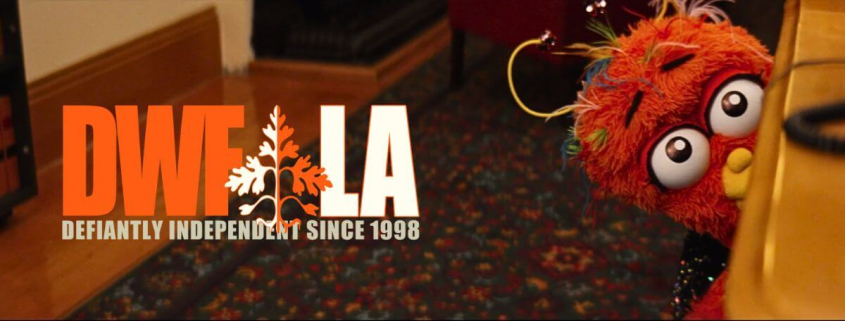
Congratulations to DEGANZ Board member, Celia Jaspers, for her new fantastical adventure short selected to screen at the Dances With Films festival in Los Angeles! Directed, written, and produced by Celia, The Polycees was chosen as one of the 250 finalists. 

The family-friendly short takes you on a wild ride through parliament, unearthing a secret government below Aotearoa’s iconic Beehive. It’s up to Lee, the prime minister’s daughter, and Spoo, a cheeky puppet creature, to keep the secret of the bustling network of The Polycees under wraps. Full of puppet mischief, sudden villain plot twists, and gentle satire, there is something for the whole family.

Image Credits: IMDb

As part of the Dances With Films festival, The Polycees will screen at the TCL Chinese Theatres in June this year. The festival highlights independent filmmakers and screens a wide range of feature films, documentaries, shorts, and animations. It is exciting to see a Kiwi children’s film included in the mix!

Don’t keep it a secret, and support The Polycees.

Last updated on 24 May 2023

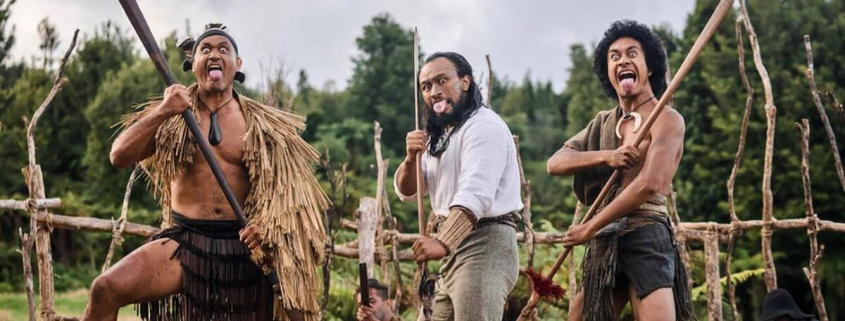
The new action-adventure drama KA WHAWHAI TONU has hit the worldwide market at Cannes. It is written by DEGANZ member Tim Worrall and edited by DEGANZ Board Member Te Rurehe Paki.

Set in Aotearoa in 1864, the film reveals the story of a crucial battle in the land wars between Māori and Colonial forces. With impossible odds between the armies, it shows courage and heroism from the Indigenous people. The historical drama, filmed in Te Reo Māori, follows two teenagers forced to make adult decisions and take hold of their destinies.

The film introduces young actors Paku Fernandez and Hinerangi Harawira-Nicholas in the lead roles. It also stars Temuera Morrison (Ngāti Whakaue, Ngati Maniapoto), Cliff Curtis (Ngāti Rongomai, Ngāti Pikiao), and Jason Flemyng (X-Men: First Class).

NZFC’s He Pounamu Te Reo Māori Feature Fund Initiative, New Zealand on Air, and Te Māngai Pāho provided funding for the feature. Tim also received assistance from the Sundance Native Lab.

KA WHAWHAI TONU is set to release on Matariki Weekend in 2024. This release corresponds with the 160th anniversary since Chief Rewi Maniapoto refused to surrender and proclaimed, 

E hoa, ka whawhai tonu mātou, Āke! Āke! Āke! (Friend, we will fight on forever, forever and forever!).

This famous phrase still leads to calls for sovereignty today. 

As Tim said to The Hollywood Reporter, 

It has been a great privilege to be part of telling this story to honour our courageous ancestors who fought and died to ensure that we survived.

Last updated on 22 May 2023

View from the Top banner

Here at DEGANZ, we are working through an educational and information campaign as part of our work around the Screen Industry Workers Act (SIWA).

One of the things we are asking editors, assistant editors, and directors to do for themselves is to look at the last ten jobs they did, the number of episodes and durations of the content, the platform it was for, what the total budget was, and then to write down the rate that they were paid to do those jobs. (You can often find the total budgets on the NZ on Air, NZFC, and TMP websites under funding decisions.)

Most people are required to work a 10-hour day, so it’s then a good idea to look at the hourly rate you got.

The current Minimum Wage is $22.70/hr; the current Living Wage is $23.65/hr. So if you do a 50-hour week that’s $1,135.00 Gross at the MW and $1,182.50 at the LW. By looking at your Gross weekly figure, you can see how you compare against the minimum and living wages.

But did you do a 50-week? Or did you do more hours and not get paid anymore for them? This will naturally decrease your hourly income. Why not average out your estimated hours per week and then see how well you did in comparison.

Directors, editors, and assistant editors don’t normally get paid overtime, but are required to work the same work day, being 10 hours, that crew on set work, who do get paid overtime.

The current Blue Book, which lays out the terms and conditions under which crew work, specifies that a standard crew day for a short-term engagement is 10 hours including paid lunch, with overtime at T1.5 for the 11th and 12th hours, and T2 for any time over that.

Most directors already understand that they are often the lowest paid person on set from the start for all key/HOD roles, and it just gets worse if they factor in the hours over 10 they do, while the pay to their key/HOD collaborators climbs with the overtime rates they receive.

All of the above and more will factor into our thinking when it comes to considering what minimum rates should be under SIWA for the various roles we represent in the sub-sectors the work is done—Factual and Entertainment, Scripted, Film – Narrative and Documentary, and Advertising and Marketing Content.

Then there are terms.

NZ crew as we know work hard, but as anyone will tell you, there are times when the crew isn’t working because they are waiting for talent, light, rehearsals, or myriad other things.

Editors and assistant editors however don’t have the luxury of downtime waiting for others. They are usually at it for all those hours of that 10-hour day. That’s significantly different in comparison to the crew. Who decided on the 10-hour day in the edit suite many are now starting to ask, not just because it affects their well-being but because it can affect the quality of the work.

We are having to weigh up many aspects of the current paradigm of work in the screen industry for directors, editors, and assistant editors before we settle on what we will negotiate for when it comes time to enter collective bargaining. What to do about public holidays, turn-around times, the working day, creative rights for directors and editors, and a host of other issues are all under discussion. And then of course we have to solidify our thoughts and come to you all to see whether or not you agree with where we have gotten to before we can start collective bargaining. If you don’t, then we will need to do more work.

Collective bargaining for us requires the employment of a democratic process designed to ensure that the majority are involved in the decision-making leading up to, during bargaining, and in settling on the final terms and conditions we will work under going forward.

There’s no better example of this in action than the screen guilds negotiations happening in the United States at the moment. The Writers Guild of America has kicked it off. The Directors Guild of America is about to start. And the US Screen Actors Guild will follow shortly.

A 98% majority vote by WGA members gave their board the endorsement to call a strike. And they eventually did after negotiations between the WGA and the Alliance of Motion Picture and Television Producers (AMPTP) reached an impasse. Democratic votes will be employed at various steps by all those guilds from here on in, in negotiations until they reach solutions.

We’ll be doing the same under the Screen Industry Workers Act, but in our own way, not following the US model.

And that’s why it’s so important right now for every screen worker to join the guild that best represents them: DEGANZ, NZWG, Equity NZ, SMSG, SIGANZ, VFX, Motion Designers and Animators, or the producers’ associations SPADA and APA (formerly NZAPG). These organisations will be negotiating on your behalf and they need your support to make it work for us all.


Tui Ruwhiu
Executive Director

Last updated on 11 May 2023