

View from the Top banner

Well, it’s done and dusted. We have another Trump presidency. So what does that mean for our screen industry?

Unfortunately, it would seem we have a volatile future in store.

As Trump has been telling us pretty much from Day 1, he wants to ‘Make America Great Again’.

He’s clearly indicated he wants to put tariffs on exports into the US market. For New Zealand, that could mean a 10 – 20% tariff on our NZ$8.8 billion exports to there. That will hurt our economy further and it’s already fragile. Shifting to other export markets may not be enough. The current government has instituted many cuts, including to a number of our cultural funding institutions, in its efforts to turn the economy around. With our exports suffering, we can expect little support and possibly more belt tightening in the arts and culture sector.

The Hollywood studios will benefit from the touted reduction in US corporate taxes from 21% to 15%. And they already have the ability to immediately write off the full cost of film and TV productions that a Trump bill introduced last time. But Hollywood hasn’t proven itself a friend to Trump, with many high profile celebrities and guilds openly backing Harris. We know Trump can be vindictive, as evidenced by his threats and or actions against CNN, Disney’s ABC and CBS. Many in Hollywood and the entertainment industry will undoubtedly be seeking shelter as he lashes out at anybody who went against him this election. Instability in the US entertainment sector means instability in the global entertainment sector, including for us.

The New Zealand Film Commission has a planned LA Showcase coming up in the next month. With so much uncertainty about to ensue in Hollywood, now may not be the best time to head there to drum up business.

Undoubtedly, one aim of any NZFC visit to LA would be to encourage more runaway production to New Zealand. However, one thing that may result from a Trump presidency is more studio production staying stateside, to help ‘Make America Great Again’. The international production pipeline in New Zealand from the second quarter of next year is already looking dicey. If the majority of now reduced US production stays there, a drop in internationals coming to NZ combined with an already slim funding stream for domestic production doesn’t bode well for us.

It’s hard at this point to see any upside for the New Zealand screen industry from a Trump win. Our best hope at this point is that we don’t experience a downside, even though there are signs that it may well be in the offing.


Tui Ruwhiu
Executive Director
View from the Top banner

In May of 2024 in France, New Zealand showcased export products, and promoted inbound investment into New Zealand at the largest industry market event of its kind in the world for this particular sector.

The trade mission was attended by industry partners, global conglomerates, foreign government entities and individual businesses looking to partner with New Zealand.

The event is called the Marché du Film or Cannes Film Market. The NZ trade mission was hosted by the New Zealand Film Commission. They do it every year.

Now a lot of people, NZ film industry people included, have a very uninformed view of what goes on at the Cannes Film Market, thinking it’s a rosé-drinking soirée where people swan about at a beachside town on the French Riviera having fun.

Even worse, outfits like the New Zealand Taxpayers’ Union are more than uninformed.

The New Zealand Film Commission got slammed by the Taxpapers’ Union for sending four staff to the most important film business market in the world and spending $145,354.81 for the whole thing. Read about it here.

I have been fortunate to attend the Cannes Film Market multiple times, and I can tell you that nobody works harder of all the New Zealanders who attend than the NZFC staff who go there.

They work their butts off helping NZ filmmakers and companies connect with the right people, while promoting our films, locations and industry, and developing and building networks within the international film arena that will benefit us all, both culturally and economically. And a good part of this work is done through the events they host—which are in competition with many other such events going on each day during the market. I believe the funding NZFC puts into the Cannes Film Market is money well spent.

Yes, there is lots of rosé drinking done, and there are lots of parties during the Cannes Film Market as well as all the specific business-focused events. But it is the entertainment industry and it is show business. Nearly all the events in Cannes—and there are hundreds—are mostly done with a purpose: to do film business.

Everybody is on the hussle, 24 hours a day, trying to get deals done across breakfast in the morning, lunch during the day, dinner in the evening, in the meetings and events that are happening all day and night, as well as on the dance floor at 2AM with a glass of champagne in hand at some swanky multi-millionaire’s residence in the hills, or on a luxury yacht in the harbour that you’ve been fortunate (or unfortunate) enough to get invited to. You never know who you are going to meet, when and where, to help get that next project going.

We Create (former Copyright Council), of which DEGANZ is a member, has done a stellar job reframing the NZ creative sector by talking up its economic value as well, so that those in government without a creative bent and understanding can more easily get our industry.

Perhaps as I did at the beginning of this piece, NZFC should rename its festival and market attendances as trade missions for the same reason.


Tui Ruwhiu
Executive Director

View from the Top banner

TVNZ has to find another $30 million in savings.

Advertising revenue fleeing to offshore companies operating digital platforms is just one of the broadcaster’s major issues.

While audience viewing habits are stabilising on platforms in New Zealand, free-to-air broadcasting as we know it is going into its death rattle here.

It looks like all efforts are on building up TVNZ+. Finally.

But we have to ask the big question here: How did successive boards at TVNZ fail to identify the issues and not get the broadcaster onto the even keel the Government is asking for long before now?

The writing has been on the wall for years internationally. And we all know that if offshore markets catch a cold, we get the flu, or even worse, pneumonia.

Are we now truly seeing the problems of the commercial public broadcaster model and the separate public TV and radio service really coming home to roost?

TVNZ’s proposal to shutter its online news operation to focus solely on video might seem like a good strategic move, but it’s going to strengthen the already powerful The Herald, Stuff, and now RNZ, who has grown website traffic significantly. At the same time, Stuff, who is now doing Three news, is going to focus more on video, too, it seems. It could well be that with TVNZ downsizing, we all might see less a merger and more a takeover of TVNZ by RNZ.

So what  do TVNZ’s current woes mean for those of us operating in the independent sector?

Well, obviously they’ve got less money to play with, so they are already paying less in license fees for local content. That’s possibly going to get worse.

We’ve seen a couple of hundred or more highly proficient storytellers lose their jobs at TVNZ and Warner Bros. Discovery in recent times. If they’ve stuck around and still want to tell stories on screen, whoever’s left will likely be going after the limited pool of funding like everybody else. That number will undoubtedly increase if more jobs go at TVNZ in the next planned restructure.

With audiences fracturing, and NZ On Air committed to it diversity and inclusion funding strategy and unwilling to put up much in the way of equity investment, budgets for most NZ shows are going to remain low. That means continuing low rates of pay for everyone in domestic production without that illusive offshore money filling the financing gap.

Over at Warner Bros. Discovery NZ, things don’t seem a whole lot better.

In August this year it announced a $138.2 million loss for the 12 months ended December 2023. Meanwhile in the same month, The Wall Street Journal reported its parent company in the US suffered an 11% plunge in its share price after a US$9.1 billion write-down of its TV assets, sparking doubts about its broadcasting business.

How much longer is the US$41 billion-in-debt parent going to put up with its loss-making Kiwi child?

Adding to the problems: Google rattled the cages last week—again—threatening to stop promoting New Zealand news content and stop deals with local newsrooms if the government goes ahead with the Fair Digital News Bargaining Bill. Read about it on RNZ here.

It does seem, though, that our current Government isn’t operating on much more than a hope and a prayer for the screen sector—just like the last one to be honest—that things will get better all by themselves.

Pain is a relative word in our business, as we are all into an element of figurative self-flagellation anyway in pursuit of our passion to create stories for screen.

Look for that uncomfortable feeling to continue for the near future without divine intervention.


Tui Ruwhiu
Executive Director

I remember being asked in university what I wanted my career to be. Many of my peers were saying Director, Producer or DOP- my answer was Production Assistant (I think I was a bit realistic about what opportunities were available to me leaving university and I’m glad to say I have exceeded my goal!). Deep down I knew I wanted to be a Director and Producer but I knew that goal was going to take time and hard work- and boy did it. 

At the time I was very lucky to be an unpaid intern for Luke Nola of Let’s Get Inventin fame. I would go into his office and scrub, clean and make coffee. Luke still mentions my window-washing skills and I always credit Luke for my start in this industry, as it’s a hard nutshell to crack without someone taking a chance on you.

Thanks to my credit on Luke’s show, I got my first offer as a proper Production Assistant (killing it) working for another Children’s television show Sticky TV for Pickled Possum Production. I will be upfront, it was rough work. 

There were presenters, children, a large farm as a set, farm animals, mud, “poop” and 256 episodes to complete and very little time to do it in.

Justin showing off his flecki skills / Photo: provided

It was a gauntlet run of prop making, people wrangling, unpaid OT, camera logging and all other forms of production shenanigans which I shared with two amazing humans Sheldene Seth and Elizabeth Koroivulaono. Elizabeth has just released an amazing documentary The Forgotten Pacific and Sheldene now does amazing work in the commercial space as a Producer. The three of us still cackle in horror about some of the tasks we had to do and the immense pressure we were under to deliver.

I remember feeling like it was all too much and I would often feel like giving up. The Props Department, which we all referred to as the “backroom”, was a place we would often go to vent, hide or cry. We all believed in and supported each other and I credit this little team as a key to persevering through it all. I think we all credit the large expectations to deliver to our own work ethics now and perhaps to our tenacity and the success we have all achieved.

Behind the scene of a photoshoot / Photo: provided

I do think times have changed–there isn’t this immense expectation of life or death to deliver but also there is a much more positive kaupapa around content creation, how we look after our younger crew members and advocacy for safer sets and conditions. These days in my current roles I always make sure I’m sharing knowledge with younger crew members and building them up. I wish I had people like this when I started and I like to think those I have helped up will do the same to others. If there is anything I can pass on to emerging creatives, it’s that it’s a lot of hard work to achieve the career you want but it’s important to advocate for yourself and know what safe working conditions are.


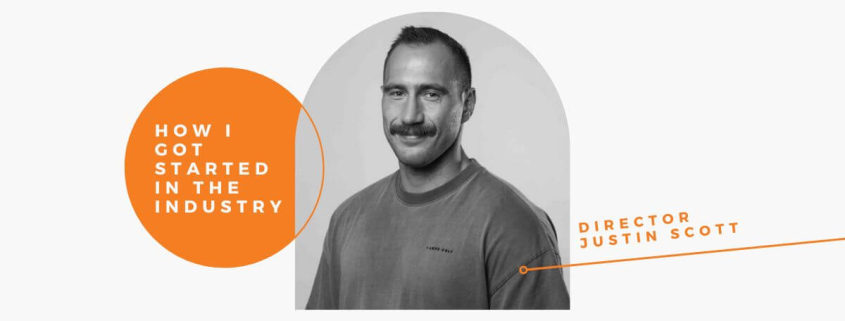
About Justin Scott

Justin Scott (Ngāpuhi) is a Director and Producer who prides himself in sharing stories from underrepresented communities. As a Queer, Māori, Neurodiverse man living with ADHD, his practice often touches upon stories from these communities and explores intersectionality. Most recently, Justin worked as a director and associate producer for the TVNZ series Four Go Flatting – following four young men with intellectual disabilities tackling flatting and independence for the first time. He has been working as a director for the Sunday morning series Attitude for the past four years, also directing on the company’s children’s show George and Me for HEIHEI, and intersectional series What’s the Disabili-tea for RNZ. Alongside his directing work, Justin has produced numerous short films with a Te Ao Māori focus including He Hekenga Tūhura and HAKA HAHA. Both of these films have had successful international festival runs, with both premiering internationally at the world’s largest Indigenous film festival ImagineNATIVE in Toronto.

How I Got Started in the Industry is a guest blog series from the Directors and Editors Guild of Aotearoa New Zealand (DEGANZ). Our members reflect on how they made their way into assistant editing, editing, and directing—with no two stories the same. They offer advice for those starting out. Get in touch with admin@deganz.co.nz if you’re a member and would like to share your story.

View from the Top banner

As always, the New Zealand On Air ‘Where Are The Audiences?’ research provides interesting insights into our behaviour when it comes to content on screen. And stimulates interest in what else is affecting our sector.

Broadcasters are possibly breathing a small sigh of relief about TV being second most popular after global video sharing platforms (YouTube, Facebook, Instagram, etc.), while TV has the highest reach during traditional peak times (6 – 10:30PM), and the highest engagement with Kiwis consuming over 2-hours a day across all TV formats.

Netflix remains by far the most popular Subscription Video On Demand (SVOD) service reaching 38% of New Zealanders, but both consumption and engagement with SVOD have decreased since last year.

In the US, SVODs are now facing high churn rates of subscribers. The high cost of multiple SVOD services is making people rethink their spending. At the same time, the rapid rise of Free Advertising Supported Television (FAST TV) delivered digitally is making them drop their SVOD services. SVOD companies are now starting to bundle in the way that cable channels used to, to help reduce churn.

Linear TV is one of the components of the FAST TV offering, providing traditional broadcasters with hope of a second life. Learn more about FAST TV here.

While we haven’t seen the rise of FAST TV in NZ yet, the cost of multiple SVOD services amidst our cost of living crisis is undoubtedly causing some Kiwis to cut back.

Our broadcasters, however, are still left with trying to figure out how to deal with the haemorrhaging of advertising revenue to the global video sharing and digital platforms.

The Fair Digital News Media Bill, which in part was designed to assist them, has just gone through a further round of review as it passes through Parliament. And the NZ Herald has just written a piece today about the fight (read bullying) that Google is putting up to the Bill to get its way here as it has done in Canada, and is trying to do elsewhere. Read here.

I imagine TVNZ is taking heart from NZ On Air’s research as it identifies its news as being the most trusted source for New Zealanders by a large margin.

A couple of other interesting points gleaned from the research:

  • Older people (40 – 59) are taking over Instagram, just like they did with Facebook
  • The kids (15 – 24) seem less interested in online gaming, and more interested in podcasts.

As in previous years, things are looking a little sad for TVNZ 2 (18 – 49), while TVNZ+ (18 – 54) continues to justify its investment. You do have to wonder when TVNZ is going to bite the bullet, turn TVNZ 2 off and move everything over to Plus.

Overall, NZ On Air’s research indicates to me that things have stabilised somewhat. But we still operate at the vagaries of international screen winds, which are going to keep blowing and buffeting us about as always.


Tui Ruwhiu
Executive Director