
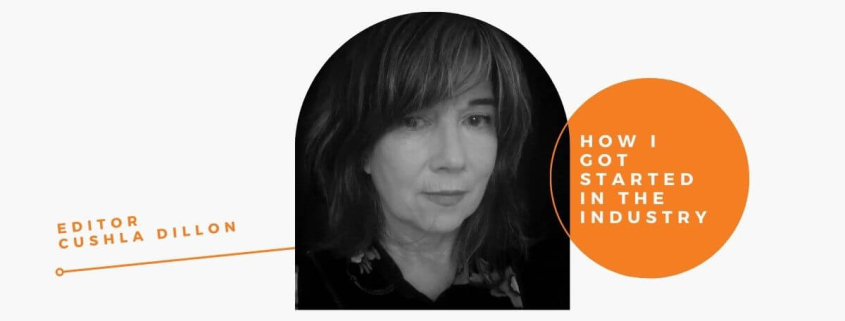
When I started back in 1986 (my first official job was as Director’s assistant on ‘Starlight Hotel’) the only ‘filmmaking’ courses in NZ were a Masters in Broadcasting at the University of Auckland and a newly established Broadcasting school in Christchurch. So my only option was writing letters to film producers asking for jobs on productions. Even though I’d trained at Radio NZ as a studio operator, none of the producers or production managers were interested in my ‘sound engineering’ skills. But when I said I could type, they couldn’t hire me quickly enough.

I was obsessed with films – filmmakers, arthouse films, foreign films, the history of films etc. I went to the Film Society, and the festival was my yearly indulgence. I read the local industry trades so I knew the names of crew members and what they had all worked on. I look back now and realise I was a bit of a ‘trainspotter’, but knowing all this information meant I stood out as someone who really wanted to be in the industry. I continued to work in production for the next decade as a Producer’s Assistant, Director’s Assistant, Production Coordinator, Production Manager, 1st AD, and 2nd AD. But I also made short films of my own and was happiest when editing them. This was where the magic happened, where films were truly made. It was time to switch roles in the industry and learn how to edit.

At the time, TV3 allowed people to train for free in their newsroom (I don’t think it was official, it was a word-of-mouth thing – it would never fly today!!). You could cut news stories during the very quiet times of the day, and then when you felt confident or they felt confident in you, they could offer you a job. All this time, I was working as a waitress at night, and continued this for many years as I got my freelance career on track.

Cushla cutting ‘The Justice of Bunny King’ in Kauaeranga Valley, Thames.

I look back now and realise I was instinctively obsessed with story: how we told stories, why we told stories, how other cultures told stories, why some films moved me, and why others didn’t. I loved going to the movies and I LOVED being moved to tears, to joy. And that’s why editing is the best place for someone like me, as the editor is the conduit between the audience and the material the director brings to the edit room.

All these obsessions and developing skills came together one day when director/actor Harry Sinclair approached me to edit a TV series idea he had called Topless Women Talk About Their Lives. I’d never edited drama before (except my own short films) but we clicked. My instinct for storytelling made up for my lack of technical experience, and this TV series morphed into a feature film. Two years later I received an editing award for my work on that film, and this stroke of luck meant people saw me as an editor. 

My advice to anyone wanting to break into the NZ film industry is to use the tools at your fingertips to learn who is who, what they have done before, and be really clear about what kind of films you love and why. For editors, the key is to understand storytelling and the huge scope of how we can tell stories. For me, screen stories are constantly pushing the boundaries of how stories are told, and I include documentary when I talk about storytelling.

But also, I believe working in our industry is a privilege we have to earn, as all artists do. So it requires the right balance of ego and humility, madness and caution. There is nothing wrong with being passionate about what one does, but at the end of the day, we are just storytellers and part of a team, so we must prove we are team players as well.


About Cushla Dillon

Cushla Dillon has played key roles in the NZ film industry for several decades, most notably as an award-winning feature film editor of drama and documentary (The Justice of Bunny King 2020, The Price of Peace 2014, Pictures of Susan 2012), but also as a production manager, development manager, screenwriter, script editor and most recently as co-director and editor of the 2023 NZIFF festival sellout King Loser. She has been awarded Best NZ Film Editor on four occasions (Snakeskin 2001, Topless Women Talk About Their Lives 1991, Beautiful Machine 2012, Orphans & Kingdoms 2014) and nominated four times.

How I Got Started in the Industry is a guest blog series from the Directors and Editors Guild of Aotearoa New Zealand (DEGANZ). Our members reflect on how they made their way into assistant editing, editing, and directing—with no two stories the same. They offer advice for those starting out. Get in touch with admin@deganz.co.nz if you’re a member and would like to share your story.

View from the Top banner

Television is the bread and butter of the screen industry.

More; What we see on our screens reflects who we are as a nation and its peoples.

News and current affairs play a vital role in this, telling us what’s going on in our little corner of the world, as well as elsewhere. It informs, educates and sometimes entertains us.

I have to admit to being a news junkie.

At one point, I worked for a short time at the global video news agency Visnews before getting a job at the global news and financial information provider Reuters. I have over the years counted a number of journalists as my friends, and have worked with many former journalists in television, corporate communications and PR. Journalists are driven by what they do and fervently believe in providing balanced coverage as well as in-depth analysis to help us all learn about and or understand issues. I believe they and their work are vital to any society.

The devastating loss of Warner Bros. Discovery’s Newshub has been compounded by the proposals at TVNZ to reduce news programmes and eliminate both SUNDAY and FAIR GO.

I was confounded when I heard that the TVNZ board had rejected Warner Bros. Discovery’s proposal to establish a NZPA-like shared news-gathering service before either of them announced their cuts. It seemed somewhat like cutting off one’s nose to spite one’s face.

While Radio New Zealand provides an excellent source for news, current affairs and other factual and entertainment programming, it’s not really screen content even though they throw cameras in the studios and on location—it’s still radio, and as such still has a very important place. We need New Zealand news and current affairs beaming into our living rooms, otherwise we face the cultural domination that has for decades taken over our entertainment programming.

While I personally had issues with the proposed merger between TVNZ and Radio NZ—mainly with the outlined implementation and not the strategic intention—it could have helped ensure a strong and vigorous news and current affairs approach for screen, done properly.

Colin Peacock with his Mediawatch column of 10 March here, gives an excellent perspective on the situation, including a very salient interview with Tracey Martin, the chair of the board charged with getting the merged entity up and running.

Is there hope for news and current affairs in New Zealand? Tracey Martin thinks the bureaucrats need to go back to all the work that was done by her and that board as there are potentially a lot of answers there, which this government doesn’t seem to have at this point

What surprises me however in all the kerfuffle going on, is that scant attention is being given to Whakaata Māori, which has a strong news gathering service of its own and commitment to news and current affairs programming.

Maybe they have some of the answers everybody’s looking for.


Tui Ruwhiu
Executive Director

View from the Top banner

The proposal by Warner Bros. Discovery to shut Newshub highlights the dismal failure past and present by successive New Zealand governments, bureaucracy and those in the screen sector to grasp the seismic changes that have flowed through our wider industry across the last twenty years, exacerbated in large measure by the global tech giants and streamers, particularly in the last ten.

A large part of the responsibility, in my view, lies with the neoliberal economic reforms brought about by the Rogernomics Labour Government of the 1980s.

New Zealand’s commitment to free trade from both sides of the political spectrum was firmly cemented in the Uruguay Round of the General Agreement of Trade and Tariffs (GATT). We were so determined to open up markets for our agricultural produce and flush with success when the Round concluded in 1994, that we paid scant attention to the potential impact of free trade on our audio-visual and media sectors when we signed up to the General Agreement of Trade and Services (GATS) in 1995. New Zealand was one of only 13 countries that made market-opening commitments in the audio-visual sector, which includes ‘multimedia’ services. Australia negotiated a specific exception. Other countries like Canada and those of the European Union have exceptions like domestic content requirements, screen quotas, divestiture requirements, foreign ownership restrictions and other protectionist measures to ensure their cultures, their stories, and their screen sector and media businesses have an opportunity to adapt and survive in the face of intensifying global competition.

But no, not us.

We have for decades continued down the free market path. Even worse, when the writing was clearly on the wall for our screen and media businesses years ago, we had become so inculcated with a free market mentality that we did practically nothing. And still haven’t.

Our broadcasters and media companies have been screaming till they’re blue in the face that the global tech companies are sucking up all our domestic advertising revenue, making it increasingly unsustainable for them to operate. And the streamers are all getting in on the act now. Meanwhile, the streamers have so dramatically altered the landscape for film and television content that we are struggling to have our cultural voices heard.

While the global entities point to GATT, GATS  and the World Trade Organisation as justification for their right to dominate, we could still have changed our approach and it would have been accepted. But we didn’t. The former Labour Government’s proposed Fair Digital News Media Bargaining Bill and other protectionist measures are ten years too late. And the Bill is looking rather like a deceased feathered thing right now. The current government from the majority of their responses to the Newshub debacle seems relatively unconcerned, believing companies need to innovate to survive and that there are more than enough media voices about.

Meanwhile, international serviced production, the lack of financial support for domestic content creation and the blinkered approach by our screen sector including our funding bodies to identify, truly understand and rapidly adapt to the global shifts in our business, has those of us dependent on domestic production facing a future of dire uncertainty.

Leave it to Winnie to deliver that unexpected twist in the Newshub story: “A critical part of any democracy and free society is the fourth estate and an independent fourth state, and I am concerned about where we are going now,” he said.

I remember the excitement and energy that flowed through the industry when TV3 got going in Flower Street all those years ago. A lot of the people bubbling about the place were journalists but also included all those in the independent sector thrilled that somebody other than just TVNZ would be controlling their future.

It’s a sad day to see the likely demise of Newshub and the loss of the hundreds of jobs that will accompany it, and what it will mean for our democracy and our journalism.

It’s going to be even sadder when the impact of the Warner Bros. Discovery decision and others to come directly shake up our own little corner of the screen universe forever.


Tui Ruwhiu
Executive Director

View from the Top banner

There’s a coalition government in power now whose focus is on the economy and righting what they see as the wrongs of the government before.

I decided to go trawling to see if there was any hope for the arts, culture and heritage or the media and communications sectors in the government’s communications.

A visit to the National Party website—some of which is still worded as if they haven’t won the election yet—didn’t turn up anything. I reviewed the Eight Point Commitment Card, the Fiscal Plan, the 100-Day Action Plan and the 100-Point Action Plan. Nothing.

Next, I took a look at the NZ First Website and the NZ First National Party Coalition Agreement. Nada.

So I went to the Act Party website and their coalition agreement with National. No rays of sunshine there.

I took a look at what our Ministers, Melissa Lee for Media and Comms and Paul Goldsmith for Culture and Heritage, have been saying via speeches and press releases. A couple of warm fuzzies but not for the screen sector from Minister Lee. And from Minister Goldsmith, some press releases from his other portfolios.

Getting desperate I went to the Ministry of Culture and Heritage’s (MCH) website and read the Overarching Briefing For The Incoming Ministers for Arts, Culture and Heritage 2023, and the Briefing For The Incoming Minister For Media and Communications 2023. At last something positive. Sort of.

The briefings are documents to inform the incoming Ministers about their portfolios. And some hopes from the Ministry on what they would like the Ministers to consider and do, in light of the government’s priorities as outlined in all the plans and coalition agreements mentioned earlier. Which of course had nothing to say about arts, culture and heritage, and media and communications. But as the government has made it very clear what its priorities are, MCH has, where possible, linked those priorities directly or indirectly to the portfolios.

A few things stood out to me.

  1. MCH did bring up copyright around content, a revenue generator.
  2. They also spoke to the possibility of a streamer levy to assist with the production of local content—a way to add to government investment.
  3. There was mention of the New Zealand Screen Production Rebate as a possible source of funding for a ‘skills levy’ or to develop and implement a ‘skills plan’. Another way for the government to utilise non-government funds for a positive outcome.

DEGANZ spent a considerable amount of time and some money seeking to get our views heard when the Copyright Act Review was live and active. We want directors to share in the copyright with producers for cinematographic film and audiovisual content. The Review was halted but it will definitely come back, particularly with AI being such a big issue now.

We have long advocated for a streamer levy, and when SPADA announced towards the end of last year that they too wanted to pursue it, we were pleased. Good to see MCH talking about it.

In the New Zealand Screen Production Investment Review, we welcomed the possibility of a levy built into what was then called the Screen Production Grant and is now the Screen Production Rebate. But we want it to apply only to international productions, not domestic productions—the last thing we need is for another new line item to chip away at what are already miserly budgets.

Although the government is certainly missing in action at this point when it comes to the portfolios that impact us directly, it’s good to see that MCH is pushing some things we have focused on in which this current government could see value. Now we have to get the Ministers to see it and get behind it.


Tui Ruwhiu
Executive Director

View from the Top banner

You’d have thought things might have settled after the COVID years. But, no, it’s still crazy. And what a year it’s been.

The long mooted merger of TVNZ and RNZ finally fell over.

The $60 million taken away from NZ On Air returned with an additional one-off $10 million.

The New Zealand Screen Production Grant, after months of uncertainty, while MBIE and MCH tried to figure out what to do, ultimately with a few tweaks became the NZ Screen Production Rebate.

New NZFC CEO Annie Murray replaced the missing-in-action David Strong and kicked off a major shake-up at the commish, appointing a Change Manager in Dana Youngman.

The writers’ and actors’ strikes in the U.S. that essentially paralysed Hollywood and shook up the global screen industry for half a year were resolved, with the actors’ membership just ratifying the deal.

We now have a three-party coalition government with Paul Goldsmith as Minister of Culture and Heritage, Melissa Lee as Minister of Media and Communications and Economic Development, and Brooke van Velden of the Act Party as the new Minister of Workplace Relations and Safety, from whence the Screen Industry Workers Act sprang.

DEGANZ became the talk of the town with its opposition to a British director directing ‘New Zealand’ film The Canyon, which tells the story of a woman who finds herself in peril traversing the Grand Canyon. It went ahead despite our protests.

And the television of unease that has been After The Party has concluded to rapturous acclaim. It seems our now eschewed, uniquely strange and dark film industry traits have permeated Kiwi telly to good effect.

Just some of the things making 2023 a momentous year. So what’s coming up in 2024?

I’m aware of at least four international productions arriving on our shores over the next few months, so if you are looking to hire experienced crew for a scripted production, good luck. If you are a graduating film school student or someone looking for a job change, however, a below-the-line crew job probably won’t come any easier.

A $6 million budget cut at NZFC doesn’t bode well for NZ film unless the board gets off its chuff and finds more money for the org. to make films with. Perhaps SPADA’s about turn on the idea of a streamer levy might inspire the NZFC board to look further than government coffers.

NZ On Air is full of enthusiasm about its role as a multi-party and gap financier for New Zealand productions with international finance partners and the opportunities that might bring, thanks to the Screen Sector Investment Review. Quite how this fits with its focus on making content for New Zealanders first and with a free-to-air remit is going to be an interesting watch.

Warner Bros. Discovery and SKY seem to be finding their mojo while TVNZ still seems a bit aimless with no replacement for former CEO Simon Powell in sight. How to make a commercially-driven,  public-broadcasting behemoth into a lean and fit, profitable fighting machine amidst a world of declining advertising revenues is going to be a herculean task for anyone in 2024.

As I’ve mentioned previously in this column, the international streamers are going to make you pay for the pleasure of watching advertising on their platforms. This seems to have inspired local streamer Neon to up its prices and announce the introduction of advertising. We’ll find out how Kiwis respond to that.

At the same time, the mad rush of streamers to make original content and own it is now on the downward slope, with licensing programming the new mantra. After ten years of peak TV drama internationally, we seem to be just finding our feet locally with shows like Far North and After The Party (two Premium Drama projects). As we never got in on the international streamer commissioning act except for the long ago Dark Tourist, licensing might prove to be our saviour.

At the Guild, we have a new board in place filled with enthusiasm for the work in the year ahead. There’s going to be a lot.

Undoubtedly, the changes coming at NZFC will not suit everyone, and there will be discussions to be had. The ever-changing marketplace for content brings both opportunities and challenges for our members and our industry that will require our attention. The need to remain financially viable in these tough economic times for everyone, demands our focus, too. Then of course there’s the new government and what that will mean for our industry. And once again, thanks to NZFC, we have a comprehensive professional development programme to roll out in the coming year.

It’s important though to take stock of where we are at right now.

We have improved membership numbers, though we still need more to help us do our work. We have good working relationships with the funding bodies and organisations that impact our sector. Collaboration with the other guilds and associations has grown over the last few years to a point where we communicate and cooperate effectively, even with our differences.

We have many dedicated people both on and off our board who give time, expertise and knowledge voluntarily—a special thank you from me and the organisation goes out to them.

Thanks also go to the New Zealand Film Commission, New Zealand On Air, the Australian Screen Directors Authorship Collection Society and Screenrights who have contributed financially to our operations and the work we did over the last year, and some, many years. While accounting firm VCFO, Resene Paints, and now Madman Entertainment make in-kind contributions or offer discounts or products that members can take advantage of.

I also wish to thank the staff who have helped me in 2023—Maddie Payne our Events and Marketing Manager, Izzi Hoskyn our Membership Coordinator, and our recently departed accounts person Caroline Harrow, who has seen the guild through three EDs in Anna Cahill, Fiona Copland and me across her 13 years working for us.

Things are crazy busy and will continue to be so for us here. We hope the same for you and that success will come with your mahi, however, it manifests itself.

We also hope that you find the time during the festive season to enjoy, rest and replenish your energy for 2024.

Ngā mihi o te wā


Tui Ruwhiu
Executive Director