
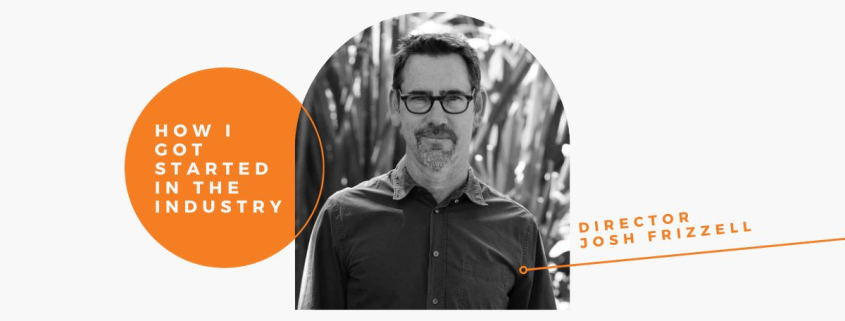
I was expelled from Penrose High in the fifth form after getting caught wagging for a month (I faked the absentee notes from Mum and Dad). I ended up going on the dole (unemployment benefit) for a year. At the dole department you had to show signs of actually seeking work and when they asked me what I would like to do for a living, I said, “A film director” and she looked at me like I was mad. She gave me a French Polishing apprenticeship instead, of which I never attended. Anyway, I showed her!

After a year of bumming around, a friend (Matt Palmer, who also became a director) suggested I go to Auckland Metropolitan High School, an alternative school in Mount Eden which basically accepted high school dropouts from hippy parents. Metro is where I finally met like-minded people and made lifelong friends. I met Matt Noonan at Metro (later to become my first producer). It was after passing the University Entrance and sticking around Metro for a seventh year (then called a Bursary year) that I discovered ‘The Film Industry’.

Early in that seventh year at school, I got a job as an extra in a period coal mining TV drama called Heart of The High Country. I’d never seen a film set before, it was a real eye-opener, lights, actors, 1st AD’s smashing radios in fits of rage. It was a lot of fun. I loved it. I befriended the standby props guy, Al Ford, and he let me do the smoke pots for background smoke texture. I actually made friends with a lot of the crew and at the wrap party offered my services on the next production. A few weeks later I was on an epic Hong Kong Feature film called Aces Go Places, as standby props assistant, choppering up the Shot Over River in Queenstown with prop machine guns on my lap. I never went back to high school and have been working in the film biz ever since.

Josh working as Art Department Assist on ‘Never Say Die’. He’s standing under the ‘W’ with Robin Murphy; Matt Murphy (Art Director) with Matt Palmer (Stand-by Props) are in the bottom right holding the white dots / Photo: Supplied

I moved to Wellington and Matt Palmer and I became a bit of a hot shot art department team working on commercials and films in the hay days (or the end of the hay days) of the Wellington film and TV commercial industry. Working on projects with some of New Zealand’s top directors, Geoff Murphy, Lee Tamahori, Barry Barclay, Gaylene Preston, Geoff Dickson and Fane Flaws to name a few. Matt was an art director and I was standby props. 

My brother was in a hip-hop band, Mc OJ and The Rhythm Slave, and they received one of the very early NZ On Air music video grants and asked us to make it. Matt Noonan produced it, Matt Palmer directed it and I art directed it.

It was hugely successful, and we went on to make a few more (with our company Hip Operations) until Matt Palmer got picked up by a commercial company to direct ads (with Fane Flaws and Jeff Williams at Black Stump Films).

With Matt Palmer busy making ads, that’s when my break came. I art directed a few more music videos with various artists. I was always good-ish at illustration and had been storyboarding the videos. One video in particular for the band Head Like a Hole (for a song called Fish Across Face), was really well received and I had storyboarded the whole thing. They were my shots and my ideas. I was like, ‘Hang on, I’m doing all the work here’. So, when they asked me to storyboard/art direct the next one, I said to them (and I remember this moment very clearly as I had to really pluck up the nerve to say it), “Not unless I’m directing it”. 

Josh on set of one of his first big ad campaigns for the NZ Electoral roll with Darryl Ward (DOP) and Rob Marsh (AC) / Photo: Supplied

And that’s how I got started.  

Here’s the Head Like A Hole clip, my directing debut. Not that it did huge things, but I was asked back and went on to direct multiple award-winning videos and ads. The Emma Paki video won a lot of awards. Then I followed up with a Shihad video for ‘Stations’ which won Best Video at the Film and Television awards that year. Certain projects catch people’s attention and simply generate more interest. I shot a huge campaign for the NZ Electoral role on the back of this, my first big proper ad campaign. I made a commercial for Sony Home Theatre Systems out of Singapore which made the cover of the Shots Magazine, with the commercial in the first dozen showcase ads (Shots Magazine was the international benchmark trade rag back then and the mail-out VHS showcase was everything). My international commercial career really took off after this.

Left: Josh showing the actors what to do on set for Shihad video ‘Stations’ with Darryl Ward (DOP) in a clay pit with one of the old Arri ST 16mm cameras. Note there is no video split/feed! Right: The final shot of the video / Photos: Supplied

My first break in drama came when I was asked to pitch on a Colin McCahon doco, but I didn’t get the gig and I said to the producer (Fiona Copland) that documentaries weren’t really my thing but I would love to do drama, and she suggested I give Greenstone Pictures a call because they were producing a kids action hero TV show called Amazing Extraordinary Friends. It was super low budget, but super fun. This was at the height of my commercial career and I had to take a significant hit on my earnings, but I really wanted to shoot drama and this was my chance. The people I worked with then on AEF are still the people I am working with today. Dave Cameron was the DOP and he shot my first tele feature years later, Ablaze. With the success of my work on AEF, I was picked up by Chris Bailey at South Pacific Pictures where I worked on multiple shows and really cut my teeth and learnt the craft. Getting a chance to direct a block on Westside, a legacy NZ show, was a real highlight. I was also a finalist for the NZTV Awards’ Best Director for The Brokenwood Mysteries in 2017. SPP has really helped a lot.

So, a lot of luck, a lot of sacrifice and a lot of hard work. I am currently in post-production on a six one-hour TV mini-series called Friends Like Her, produced by Great Southern TV. A show I am immensely proud of, so keep an eye out.


About Josh Frizzell

Josh Frizzell is one of Australasia’s most well-known drama and commercial film directors. Since starting out in the art department after dropping out of high school, he went on to direct a run of music videos in the 90s before moving into film and TV. Frizzell has gone on to helm episodes of Under the Vines, The Brokenwood Mysteries and Fresh Eggs. In 2017 he was nominated as Best Director for his work on The Brokenwood Mysteries at the NZ Television Awards’. In 2019, he was a finalist for the Huawei Mate30 Pro NZ Television Awards’ Best Director for Fresh Eggs. Ablaze was nominated for Best Tele Feature at the 2020 NZ Film and Television Awards. His advertising work has won multiple awards both in New Zealand and abroad.

How I Got Started in the Industry is a guest blog series from the Directors and Editors Guild of Aotearoa New Zealand (DEGANZ). Our members reflect on how they made their way into assistant editing, editing, and directing—with no two stories the same. They offer advice for those starting out. Get in touch with admin@deganz.co.nz if you’re a member and would like to share your story.
View from the Top banner

I’m personally thrilled to see SPADA coming out strongly for a levy on streamers recently. It’s something I’ve been advocating for in this column going back four years, ‘Show Me the Money’, ‘Time for a Reset’, ‘An Answer to NZ’s Broadcasting Industry Dilemma?’ and most recently this year in this Stuff article here.

Across the Tasman, the Australians are still pushing for a 20% levy on streamers, but you need to look to Europe to see what can be achieved by countries who truly understand the contribution that their own screen industries make to their creative, cultural and financial well-being.

Rather than write about it, I have included this table compiled by The imec-SMIT-VUB research group in September 2022 (the latest comprehensive data I could find). There’s a lot of food for thought here for SPADA and the rest of us.

Tui Ruwhiu
Executive Director

View from the Top banner

NZ On Air’s Where Are the Audiences Survey 2023 confirmed what previous reports have been warning of—the death of linear television in New Zealand. (WATA research here.)

Three telling points were highlighted in the document that attest to this:

• All traditional media continue to show consistently declining audiences, with TV no longer attracting the biggest audiences during its traditional peak time of 6-10.30pm.
• For the first time the study is showing significant declines in traditional media use among 60+ year olds, and 40-59 year olds are now at the cross-over point where digital media audiences overtake traditional media.
• 2023 also represents the cross-over point when New Zealanders overall start to spend more time using digital media than traditional media.

I’m in one of those older demographics, and I can tell you that I spend more time watching YouTube than I do watching broadcast TV.

If you look at the most popular channels, sites and stations graph, you can see that I’m one of the people who has in 2023 made YouTube the biggest attractor of New Zealand audiences each day at 44%, with Netflix sitting just behind at 42%. TVNZ 1 has gone from 48% in 2014 to 34%, while TVNZ 2 doesn’t even do well enough to get on the graph, at 11%–a death rattle if ever I’ve heard one. TV3 is the bottom player on the graph, going from 34% in 2014 to 17% this year. The rising TikTok sits two percentage points above at 19%. No wonder NZ On Air is throwing money at TikTok in pursuit of the elusive yoof audience.

New Zealand’s bastion of commercial TV media, our public broadcaster TVNZ, after a post -COVID advertising recovery under the canny watch of former CEO Kevin Kenrick, is in throes of its own. With a projected loss of $15.6 million in the 2023/2024 year due to slumping advertising revenue, the belts there are being severely tightened. Head of Drama and Scripted Comedy Steve Barr got the push under a restructure, and now Chief Transformation Officer Kate Calver (Slater) has left to take up the CEO role at Great Southern TV. A positive for TVNZ is that TVNZ+ on the NZ on Air graph has seen its audience reach grow from 14% in 2016 to 32% in 2023, sitting just under TVNZ 1. I think some acknowledgement for this needs to go to former TVNZ CEO Rick Ellis and his digital strategist Simon Aimer, who drove TVNZ into the digital era with their “Inspiring on Every Screen” strategy. With an interim CEO still in place after the departure of Simon Powell following the collapse of the RNZ – TVNZ merger, and a new chair in current NZFC Chair Alastair Carruthers, there’s undoubtedly more transformation to come in that balliwick.

Back at the NZFC ranch, Dana Youngman has been appointed Change Manager by new NZFC CEO Annie Murray, to bring about transformation that the filmish screen industry has been baying for, for years. Change there is also driven by the recent budget cuts NZFC has suffered or will face in the near future. We shall find out what comes in this space in the not-to-distant future, but for the time being we’ll just have to wait… like we’ve been doing since Annabelle Sheehan departed in 2021.

Competition has seen Netflix and some other streamers on the advertising-driven bandwagon for some time now. Netflix has just introduced title sponsorships and binge ads to its advertising offerings. At the same time, its subscription prices for their ad-carrying service and their ad-free service have gone up in the US and will soon in the UK, France, and undoubtedly elsewhere. It’s ironic when you think about it: you used to get advertising for nothing on Free to Air TV. Now you have to pay for it on advertising-carrying subscriber services.

Consolidation is coming in the streamer world is the catch cry we hear more and more these days. We are also being told that peak TV is over, with streamer budgets and commissioning shrinking. Not only has NZ completely missed the Golden Age of Television Drama globally, but it’s become increasingly harder for us to play catch up with the same old or decreasing domestic budgets–we shall see if the New Zealand Screen Production Rebate changes this.

Exacerbating the uncertainty for the NZ screen industry is the ongoing SAG-AFTRA strike. I’ve heard international productions are backed up, wanting to get into NZ to shoot. Yes, the writers are writing but nothing can be done without actors. The actors’ down-tools has gone past the 100-day mark with no real end in sight. Both the guilds and the studios while still talking do seem to be at considerable loggerheads.

I guess the only thing to do at this point is to smile and sing a little tune:

Try not to get worried, try not to turn on to
Problems that upset you, oh
Don’t you know
Everything’s alright, yes, everything’s fine…

Tui Ruwhiu
Executive Director

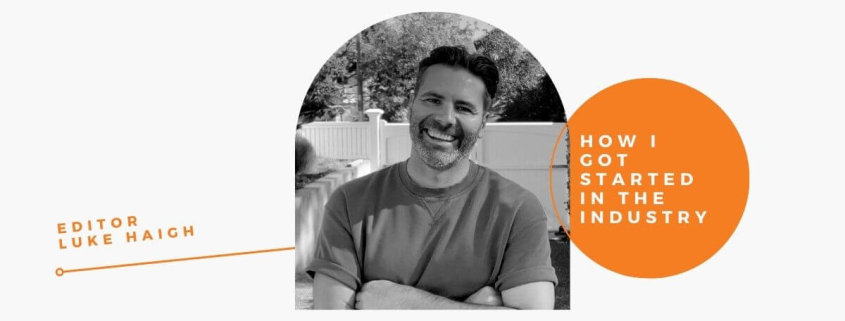
Hey there! I’m Luke Haigh, a freelance film editor who’s worked in both the commercial and feature film worlds for the last 20 years.

I first fell in love with editing around the age of 15 or 16. It was a Media Studies class in high school in the UK. We were editing linear style from S-VHS decks. It was slow and tedious, and the work was embarrassingly terrible. That was all overshadowed by the art of editing with its magic equation—the process of simply placing two shots next to each other and the sum of their parts wondrously being infinitely greater. Well, it had me hooked…

My first proper break in the industry was in 2002–2003. At age 22, I’d just emigrated to Aotearoa after studying a bachelor’s in film in the UK. I did the usual rounds, hitting up all of the production companies and post houses I could find in Auckland. But to no avail. I filled my time that summer driving a tractor on an avocado farm in Pukekohe. Fortunately for me, a friend of a friend heard of a full-time role working as a Directors Assistant at an Auckland commercial production house called Curious Film. It wasn’t editing, but it was a foot in the door.

I spent my time mainly putting together director’s treatments and preparing the pre-production meeting documents. Casting, locations, art department, etc. The hours were extreme, but the money was not. However, it was the perfect crash course in the industry. I got to see the intense creativity that goes into getting a project on film. It gave me a well-rounded view of the process rather than a singular take, which can happen when you only work in editorial or post-production. But most importantly, I got to meet directors and producers and understand what makes them tick.

After a year of dropping hints and schooling up on Avid in the background, I finally got a shot at some of the small edit gigs. Charity spots and music videos.

As Curious grew, I convinced the owners to support my post-production dreams. We took editorial in-house and grew a full-service post-production arm at both their Auckland and, later, Sydney offices. I started as a DA and Assistant Editor, and about 5 years after starting, I focused on editing and post-production full-time. That eventually saw me in the dual role of Senior Editor and Head of Post-Production.

Curious Film Pre Axis Awards (2015) / Photo: Supplied

I was lucky enough to work alongside some incredible talent during my time there. Taika Waititi, Zia Mandviwalla, Miki Magasiva, Robin Walters, Steven Kang, Tara Riddell, Matt Noonan, Darryl Ward, Seth Wilson, Dan Higgins, Josh Frizzell, Steve Ayson… the list goes on. They gave me my first breaks; we were like family, and those relationships continue in my work today.

I spliced literally hundreds of commercial campaigns during my time there, and we would spend evenings and weekends cutting short films and honing our craft. I cut my first short, USO, with Miki Magasiva in 2006, a raft of others, and finally, in 2011, I cut Blue with Steven Kang, which went on to win La Semaine de la Critique (Critics Week) at Cannes. That was a defining sea change in my career.

In 2014, I landed my first feature film edit, Turbo Kid, with producer Ant Timpson and Canadian director trio RKSS. As I was still full-time at Curious, I also post-produced and post-supervised that project. Brutal. That year was so intense. I was even late to my own New Year’s Eve party as we were racing to get everything delivered by the January deadline. I’ll forever be in debt to colourist Dave McLaren and Flame artist Leon Woods for pulling that one out of the bag. We delivered for the Sundance Premiere in 2015. It reviewed well, and finally, I was a feature film editor…

‘Turbo Kid’ Sundance Premiere (2015) / Photo: Supplied

That same year, Taika was shooting Hunt for the Wilderpeople. I did the same Editor/Post-Producer/Post-Supervisor role on that one. It premiered at Sundance 2016, and it felt like the right project to springboard off. I finally went freelance to focus on editing around June of that year.

Since then, I’ve tried to find a balance between editing commercial campaigns (here in New Zealand and repped in Australia by ARC Edit) and long-form projects. I’ve been lucky enough to edit the Daniel Radcliff action-comedy Guns Akimbo, the US Netflix rom-com The Royal Treatment (line-produced by my good friend and Curious EP Matt Noonan), and most recently Lee Tamahori’s pre-colonial Aotearoa/NZ epic The Convert, starring Guy Pierce and Tioreore Ngatai-Melbourne, which premiered at TIFF 2023.

I’m currently editing a feature with the director who gave me my very first edit gig at Curious 20-odd years ago. Miki Magasiva. Pretty cool to finally complete a loop on that relationship.

I’ve been fortunate enough to pick up a few awards along the way, only been fired once, collected a bunch of incredible people, and even after 20-odd years, it is still a job that I love.


About Luke Haigh

Luke Haigh is an award-winning freelance film editor. He’s edited feature and short films that have screened globally at A-list festivals and even won Critic’s Week at Cannes. Having cut literally hundreds of commercials, his specialty is the big kind. Beer ads, car brands, soft drinks – often on a global scale. Many go on to become award-winning campaigns – Grand Prix at Cannes Lions, Clio, and D&AD. His work can be both quirky and emotive and he will happily lean into something that’s a little unusual.

How I Got Started in the Industry is a guest blog series from the Directors and Editors Guild of Aotearoa New Zealand (DEGANZ). Our members reflect on how they made their way into assistant editing, editing, and directing—with no two stories the same. They offer advice for those starting out. Get in touch with admin@deganz.co.nz if you’re a member and would like to share your story.
View from the Top banner

By the time you read this the Writer’s Guild of America’s (WGA) strike will be over. The Screen Actors Guild (SAG) and American Federation of Television and Radio Artists’ (AFTRA)—not yet.

So what can we take from the strikes? I saw one placard from the picket lines I thought was very pertinent: A Career Not A Gig.

In simple terms—the concerns of Artificial Intelligence (AI) aside—the writers wanted to be paid fairly, to ensure that their opportunities for work were safeguarded, and that there was a development path for new and junior writers into sustainable careers.

Fair pay relates to both the amount they are paid for the work they do as well as residuals, which are payments for the reuse of the work after the initial play. While broadcast and other reuse such as on cable, etc. generates residuals, streaming does not. And with streaming dominating the world and other reuse declining, writers weren’t getting the income they used to get from residuals. And they weren’t getting any from streaming.

In America, writers, directors, actors and some other key creatives get residuals, all of which are negotiated by the guilds there, to help contribute towards sustainable careers for their members.

Do we have residuals in New Zealand? Sort of.

Screenrights collects revenue for reuse from Government, Education and Retransmission in Australia, but in New Zealand only from Education. The Australian Screen Directors Authorship Collection Society (ASDACS) collects any revenues owing from Screenrights and distributes them to NZ directors.

International organisations who collect revenues from a variety of rights on behalf of directors also pass this on to ASDACS for distribution to its members.

A share of the back-end, typically being net profit, is kind of a residual, but is dependent on sufficient revenue coming back from the income of the production and there being something left after all of the other obligations and costs have been deducted. Directors must negotiate a net profit share in their contracts to get it.

A share of the producer’s corridor that flows to the producer from NZFC for non-New Zealand Screen Production Rebate films, and a share of Producer’s Equity from New Zealand Screen Production Rebate films and TV shows can also be negotiated by the director in their contract with the producer.

Screenrights, ASDACS, producer’s corridor and NZSPR producer equity are all mechanisms by which directors can help build sustainable careers for themselves. And the opportunity to do this should be taken advantage of.

With the Screen Industry Workers Act, we hope to remove the need for directors to negotiate individually for their shares of these revenues through collective bargaining, just like the DGA does for directors, the WGA does for writers, and SAG/AFTRA does for actors in regard to residuals.

The news coming out of the negotiations is that the WGA got a lot of what they were after, including residuals from streamers. We expect that SAG/AFTRA will now quickly conclude their negotiations as well.

For New Zealand guilds, we are working towards having our negotiations in the first half of 2024. For us at least, residuals are definitely on the agenda for collective bargaining.


Tui Ruwhiu
Executive Director