
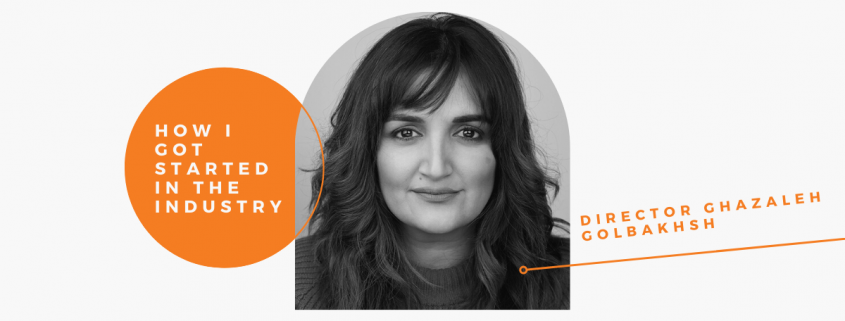
My family and I fled Iran for Aotearoa in the late 1980s due to war and an oppressive regime. As a six year old I was yelled at by teachers for not understanding English, so I set about reading and writing as much as I could to learn the language. This was aided by a family love of film. I feel like the two have become intertwined and I now have the privilege of working as a writer and filmmaker.

Being a creative means constant rejection – whether it’s work opportunities, funding or criticisms of your work. Early in my career, I wanted to become an actor so this sense of persisting despite the setbacks became ingrained in me. I also became disappointed with the lack of roles for women, particularly women of colour. So I started writing those very roles that I would have wanted myself and soon I began directing them too. At one point, I dropped out of a certain film school, bought a one way ticket to London and set about working as a runner – often for free – but loving the freedom and people I met along the way. I remember literally door-knocking around all of Soho until someone finally let me in for an interview. What I wasn’t prepared for was the bullshit sexism, racism, classism and self-indulgent nonsense that the industry was awash in. It is changing, slowly, but it’s changing.

When I returned to Aotearoa, I decided to go through the University route by completing a BA in Film, TV and Media Studies at the University of Auckland then a Masters in Documentary under Annie Goldson. It was here I serendipitously met a Fulbright advisor and randomly decided to apply for the University of Southern California. The year in Los Angeles was fundamental to me learning how to write for film as we were writing constantly. It was also an introduction to the US system which is its own beast. USC was not just a film school (what we learn here is just as good) but their resources and connections make it more like a country club for Hollywood wannabes. However, I got to work in the documentary department at the Sundance Institute – a relationship I am keen to continue fostering as I thoroughly support their mantra on supporting independent filmmaking.

Director Ghazaleh and the all female crew of This is Us (for RNZ/NZ on Air) photographed by Ainsley Duyvestyn Smith / Photo: Supplied

For me, much of my work came through the connections I made through University, including the formidable producer and writer Shuchi Kothari, plus constantly applying for funding, workshops and programs that our hard working guilds here run such as the Women’s Incubator and filmmaker workshops through DEGANZ. These events are great to meet people. It was at an early Story Camp run by Script to Screen where over a sneaky wine, I met the incredible Ainsley Gardiner, who is now producing my first solo feature with Georgina Conder and Miss Conception Films. The best way to network is to be yourself.

I am currently directing on Shortland Street. Learning to work within a multi-camera, fast turnaround format is an invaluable experience and the perfect place to hone your directing skills as you get to direct regularly. I’m also really proud of what Oliver Driver and the team at Shorty are doing with actively supporting and encouraging more representation behind and, in front of the camera.

One of my favourite speeches comes from actor and musician Riz Ahmed. Regarding representation he notes that being represented means being a part of the story. If we are absent from that story, then we feel that we do not matter. It is not enough to just put different faces on screen (as great as that is) but it is also vital to have the right people tell those stories and make the decisions behind the screen too. In my career I’ve been lucky to have had other POC women leaders as mentors who have not only helped me with work but also helped me see myself in that leadership role one day.


About Ghazaleh Golbakhsh

Ghazaleh is an Iranian-New Zealand award-winning writer and director. She has directed award-winning short films including This is Us, Iran in Transit and The Waiting Room. Ghazaleh was also one of the writer/directors on feature anthology film Kāinga, which premiered at NZIFF and the Melbourne International Film Festival this year. She is currently working on her debut feature as well as directing on Shortland Street.

ghazalehgolbakhsh.com

How I Got Started in the Industry is a guest blog series from the Directors and Editors Guild of Aotearoa New Zealand (DEGANZ). Our members reflect on how they made their way into assistant editing, editing, and directing—with no two stories the same. They offer advice for those starting out. Get in touch with admin@deganz.co.nz if you’re a member and would like to share your story.
There has been a flurry of activity around the Screen Industry Workers Bill in the last month.

On the 23rd of August the Bill had its second reading in the House.

Then it went to the Committee of the Whole House on the 31st of August.

We expect that the Bill will have its third and final reading in the house next week. We hope. It’s No. 5 on the Order Paper, so it may not be gotten to on the day if things drag out.

But if it doesn’t, what happens from there?

If the Bill gets its third reading, it is then destined to become law but not until it receives Royal Assent from the King’s (?!) representative, the Governor General. The Bill will come into force three months after it’s signed by the Governor General.

While we all prepare for collective bargaining, which the Act will allow for contractors in the screen industry, six new rules will come into effect immediately when the Bill comes into force:

  1. Duty of good faith applies between workers and their engagers
  2. Individual contracts must be in writing
  3. Engagers must follow process rules for making and varying individual contracts
  4. Individual contracts must contain mandatory terms. Existing contracts will have extra time – 12 months – to comply with this
  5. Terms must not be worse than any applicable collective contract (once it has been negotiated)
  6. Engagers can’t cancel contracts in retaliation for workers exercising their rights

If you are working as a contractor in the screen industry and are covered by the Bill, four of the above six rules will apply straight away, being 1., 2., 3., & 6.

Rule 4. will also apply if you enter into a new contract.

Rule 5. will apply when a collective agreement is negotiated.

These six rules change the dynamic of the relationship between you as the contractor and the person or company contracting you. They will be law. They must be abided by. And they are enforceable.

In other words, you will have protection as a contractor in your working relationship with the entity contracting you that you didn’t have previously.

This change in dynamic is going to take some time for everyone to get used to. It’s important however that everyone understands what it all means and how it will affect them.

We have published a simplified guide to what the Screen Industry Workers Bill means, with links to additional information.

Please take the time to read and learn about the Screen Industry Workers Bill because it’s going to become an important part of your working life.


Tui Ruwhiu
Executive Director


As if we didn’t have enough on our plate with the Screen Industry Workers Bill, the Reform of Vocational Education, The Screen Sector Investment Review, and an NZFC still in managerial stagnancy sans a permanent CEO (David Strong has resigned but there’s now a need to find a replacement), we now have the combining of TVNZ and RNZ under the new entity Aotearoa New Zealand Public Media (ANZPM) to contend with.

Following a decision by Government to move ahead with this new approach to public media, a Governance Group was established. The Group has been busy, and has published a couple of important documents.

The first and easiest to read is the Business Case Governance Group Report. This report takes an overview of the need for a restructuring of public media in New Zealand, including thoughts outside the formal review they were asked to deliver by the then Minister of Public Broadcasting and Media, Kris Faafoi.

The second document is the Business Case they were required to construct—a long document laid out in the format required by Treasury. Often repetitive in nature, it is still worth a read for the truly interested.

And for those into literary self-flagellation, you can review the draft legislation here.

Faafoi then appointed an ANZPM Establishment Board whose responsibility it is to oversee the detailed design of the new entity and the change required to create it. The new entity will come into full operation by July 2023.

With the resignation of Faafoi, the portfolio has moved to Willie Jackson, who has been quick to express his views on ANZPM and other media matters in an interview with Duncan Grieve at The Spinoff.

The ANZPM is a massive undertaking. And like so much in the New Zealand screen sector, long overdue. It will affect everybody producing content for TV and Radio and thus is of utmost interest to the entire production sector. Strangely, there is nary a mention of the New Zealand Film Commission in any of the documentation, which I find curious considering the convergence of content and distribution channels and the expressed objective of the new entity to engage, inform, educate, enlighten and entertain. NZFC after all is a public media stakeholder and the only government funding body seemingly left out of the mix in considerations.

There is a call for submissions out now with a deadline of 8 September. DEGANZ will be responding and we encourage all of you in the screen sector to do the same, whether you are a content creator or viewer/listener. The ANZPM is going to shape the way we consume Aotearoa New Zealand content for decades to come and we want it to be done right.


Tui Ruwhiu
Executive Director

I joined a children’s choir just after my 3rd birthday. That was in Yugoslavia, Zagreb, in 1983. Choir defined me as a person. I’ve learned early on we are all individuals with different needs, wants and perception, so listening is often more important than talking. We’d rehearse twice a week and occasionally perform on Sunday morning Kid’s show on Channel 1 broadcasted live from the studio at Zagreb TV. The studio lights were insanely bright and enchanting. Built sets, colourful gels, bubble machines, giant cameras on wheels, heaps of grown ups, discipline, and us kids were all needed to create those few minutes of a TV programme. The Whole is greater than the sum of its parts. I knew I wanted to be an entertainer, and I saw the beauty in the collective, not in soloing.

By mid teens, I was in a few TVCs, had a supporting role in a feature film, acted in couple of theatre plays, but started feeling uncomfortable being recognised on the streets. Rather than escaping that world, I removed myself from the spotlight, and joined the crew “behind the scenes”. I spent my 20s mostly in theatre, making music and sound design, experimenting with 3D mapping and projections, filming and editing my friends’ gigs and creating short videos for VJing. I was lucky to own a firewire HDV camera, Final Cut Express and a laptop powerful enough to deal with the footage. VJing was a passion giving me a chance to perform my own artwork without too much exposure. I was VJing for 3 bands I liked, and realised that clip making part of the process was my favourite. I wanted to edit more. I approached the team that was producing a weekly music show about demo bands, and I got the gig. It felt like playing music and Lego at the same time, but it was an unpaid job and if I wanted to edit more, I would need to find paid work before I quit the day job.

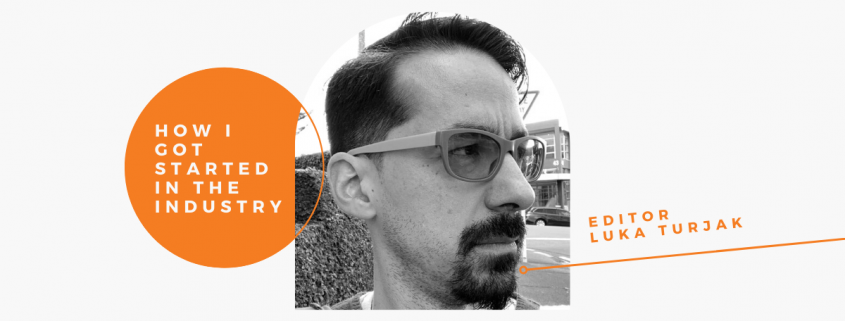
Editor Luka Turjak in his many elements / Photos: Supplied

Same year I was introduced to Željko Senečić who needed an editor to re-cut a film about Yugoslav sculptor Dušan Džamonja. It was edited in Final Cut 6 so it was a rather easy task once I found a common tongue with a director who was larger than life and 47 years older than me. Senečić had degrees in Painting from the Zagreb Academy of Fine Arts and Scenography from the Zagreb Academy of Drama Arts and he was a production designer, film director, screenwriter, playwright and way more. I on the other hand was a choir singer, had some college in Mathematics and earned money at a telephone company.

Luckily we understood each other, became good friends and in the next 6 years we made another 8 documentaries, mostly about painters and one TV drama. He supported my idea of quitting my job and turning freelance editor and theatre video/sound designer. Not the wisest thing to do during the Great Recession, but it worked out fine. It made me a happier person. I was editing art exhibition pieces for various artists and took occasional TV jobs and had time for theatre, choirs and my bands.

Editor Luka Turjak in his editing suite / Photo: Supplied

Coming as a tourist to New Zealand in 2014 was a big change. I’ve met a woman here and we wanted to explore what would living together be like. I stayed taking my chances of starting fresh. No friends, no choirs, no theatre group to belong to. I’ve taken “the long way home” approach. I didn’t know anyone in the industry yet, so I figured I’d crew for a while. Because for me, it is the people, it is the people, it is the people…

I took on everything I felt comfortable with – running, locations and unit assisting, agency/client/talent driving, ADing, DITing… I met a bunch of extraordinary people on sets, in rental and production companies who gave me greater insight into Aotearoa. When I felt the time was right, I put my hand up as an edit assist. And without forcing it I have slowly settled back into the editing chair.

Of course, I still do theatre, sing and perform, occasionally even in the editing suite.


About Luka Turjak

Luka is an experienced editor and assistant editor originally from Yugoslavia, and now based in Auckland. In the last few years, he has edited feature films In Passing and Spring Interlude, as well as documentaries, short films and music videos.

alukat.me

How I Got Started in the Industry is a guest blog series from the Directors and Editors Guild of Aotearoa New Zealand (DEGANZ). Our members reflect on how they made their way into assistant editing, editing, and directing—with no two stories the same. They offer advice for those starting out.

I’ve been at three screen events in the last week where people close by are sniffing, coughing and doing it without masks.

Why are they even there?!

At our events and many others, organisers ask for people who have COVID-like symptoms, which include those of colds and flu, to stay home. They absolutely should.

Nearly all of us are contractors. If we get sick and have to take days off, we go unpaid. Those people who turn up to events showing symptoms are selfishly impacting on all of us, even though they may think they are no longer infectious.

We now have a new COVID variant to contend with and cases are on the rise. The Government is about to announce measures to try and alleviate the increase in infection numbers and hospitalisation cases. Things are getting worse again, people.

I had one friend recently who caught the flu. He said it’s the sickest he’s ever been in his life. I said he should have gone to hospital.

It’s obvious though that the general public, and that includes many of us, have become increasingly lackadaisical when it comes to COVID prevention. People aren’t wearing proper masks in public places, and those who wear masks under their chins or just covering their mouths are only doing one thing—contributing to the pile of PPE waste. Thankfully, our COVID protocols on set are being strictly managed on professional productions. If they weren’t, producers would likely run out of crew to replace those they are losing now in significant numbers.

Every individual has the right to make a choice about their own health, but you need to be considerate and follow basic health guidelines that help prevent others from getting sick. Please:

    • Wear a mask in public when indoors
    • Don’t attend events if you have symptoms
    • Isolate if you have COVID, a cold or the flu
    • Wash your hands frequently

I at least thank you in advance for doing this.


Tui Ruwhiu
Executive Director