A couple of weeks ago, thanks to Madman Distribution, I got to watch the Cannes Jury Prize-winning Sirat, a French – Spanish coproduction helmed by French-born director of Spanish descent, Oliver Laxe.
It’s the sort of auteur arthouse fare that reminds me why I love cinematic film as a storytelling medium.
It’s an incredibly divisive film, praised and panned in equal measure by critics.
Made on a reported budget of approximately US$7.5 million, its worldwide take to date is just under US$11 million according to Box Office Mojo. If it keeps achieving more sales, then it might break even.
Now Laxe is a Cannes darling, with all of his previous three films screening there. Throw in Pedro Almodóvar as one of the producers of Sirat, and you can see Laxe and his films have the kind of pedigree that helps make an arthouse director a success at Cannes. But he had to start somewhere.
Laxe got going with his debut feature, You All Are Captains. It premiered in the Directors’ Fortnight (Quinzaine des réalisateurs) section at Cannes in 2010, winning the FIPRESCI Prize.
The Cannes pathway to success is not new. Jane Campion has walked it. Australian Rolf de Heer has, too. As have the Dardenne brothers, Ken Loach, Ruben Östlund, and Yorgos Lanthimos, amongst others.
All of these directors have been driven to tell their stories in their own way for the big screen, and often they have had to overcome seemingly insurmountable hurdles to get their first film made.
It’s something every filmmaker struggles with.
Not every NZ filmmaker wants to make a film that gets into Cannes, though. And not every New Zealand film that gets made is Cannes fare, as witnessed by the total lack of New Zealand films screening there since the last one, Christine Jeffs’ Rain, in the sidebar Director’s Fortnight in 2001.
The last New Zealand film to screen in official competition at Cannes was Jane Campion’s The Piano in 1993, while Vincent Ward has had three films screen in main competition at Cannes, two NZ features in Vigil (1984) and The Navigator: A Medieval Odyssey (1991), and international production Map of the Human Heart (1993).
What Sirat gave me, though, is confidence that cinema still has a place amid the fragmentation of screen audiences—it’s a film crafted to be seen on the big screen, with an audience. And its cinematic language is ever-present.
I also have great faith that another New Zealander will find their way into one of the sidebars or the main competition in Cannes at some point in the future, even though it’s never been tougher for filmmakers than it is now. It’s well overdue. But it will require putting aside the commercial imperative and committing wholeheartedly to artistic endeavour. And who knows, it might break even if it’s lucky.
http://degnz.sensedesign.co.nz/wp-content/uploads/2022/12/View_from_the_top_new.png7361280admin/wp-content/uploads/2021/10/DEGANZ_logo_home.pngadmin2026-02-26 11:33:372026-02-26 12:08:29Cinema Still Has a Place
The Directors and Editors Guild of Aotearoa New Zealand (DEGANZ) is proud to announce the establishment of the Aotearoa New Zealand Screen Editors (ANZSE) Accreditation for the art of editing.
ANZSE Accreditation recognises a master editor with a significant body of work that consistently meets a world-class standard.
The desire to establish ANZSE was driven by editor board members across the years wanting to recognise the world-class calibre of senior New Zealand editors, to acknowledge the mana and artistry that editors bring to their work, to provide a standard to encourage New Zealand editors to strive for, and to help identify to the international screen industry those New Zealand editors to consider for projects in New Zealand and overseas.
“ANZSE Accreditation is a mark of excellence and sets a standard for New Zealand editors to aspire to in their work and careers,” said DEGANZ President Ben Powdrell. “At the same time, it gives domestic and international producers and directors confidence that the accredited editor has a high level of technical and artistic skill.”
Led by a group of senior New Zealand editors, including DEGANZ President Ben Powdrell, Martin Brinkler ACE, Annie Collins, Tom Eagles ACE, Margot Francis, Peter Roberts and Jonno Woodford-Robinson—and with assistance from the New Zealand Cinematographers Society—a kaupapa and process was established across many months of work to make ANZSE a reality.
The inaugural recipients of ANZSE, whose work, careers and contributions were recognised at the October 2025 DEGANZ Annual General Meeting, are:
Annie Collins ANZSE
Peter Roberts ANZSE
Jonno Woodford-RobinsonANZSE
These recipients make up the ANZSE Accreditation Committee for 2026.
Each year, the ANZSE Accreditation Committee will thoroughly review applications from those seeking accreditation.
A maximum of two ANZSE Accreditations will be awarded each year if the committee considers the applicants to have attained the expected standard.
In exceptional and rare circumstances, the committee may award Honorary Accreditation to an editor whose body of work and reputation are well known and speak for themselves.
Applications for ANZSE Accreditation for 2026 open on 12 February and close on 31 May 2026. Accreditations will be awarded at the DEGANZ Annual General Meeting in September 2026.
A full explanation of ANZSE, required documents, and other support information to make an application is available here on the DEGANZ website.
While there has been a delay in the good weather arriving, it’s now back. At least for the moment where I’m sitting and writing this. In Auckland.
It’s just one of the positives of the New Year.
At the box office:
Tinā is currently at $6,486,864
Pike River sits at $1,439,550
Prime Minister is recording $1,094,292
We have two features screening at Sundance in Mum I’m Alien Pregnant and Big Girls Don’t Cry.
Crocodile is making a showing at Berlinale.
TOITŪ Visual Sovereignty, TENOR: My Name Is Pati, and Holy Days go to the Santa Barbara Film Fest, with HolyDays securing US theatrical distribution—not an easy feat for an NZ film.
This is New Zealand feature film success.
Success in TV is harder to gauge because it operates under a different model. That said, many shows are still being made with NZ On Air and Te Māngai Pāho support. We can be thankful that NZoA, TMP and the NZFC continue to receive government funding to finance screen industry activity.
International production in NZ is clearly happening with at least two new(ish) major projects underway. And the B.O. success of Avatar: Fire and Ash may give some hope to the future of that franchise.
At DEGANZ, we have two new board members in directors Jesse Griffen and Kim Webby, adding their significant experience and expertise to the guild’s brain trust. ASDACS has a refreshed board as well, bringing what we hope will be positive outcomes for directors and directors’ orgs on both sides of the Tasman.
The year ahead has challenges in front of us. As it does for all other orgs in the screen industry. But that’s nothing new. Every year now brings instability and change driven by local and global pressures that we just have to ride out as we have done to now.
We have some exciting workshops and events coming this year. More on these later.
And with the election called for 7 November, we all have an opportunity to help determine our futures by voting.
Wishing you the greatest success in your endeavours in 2026. DEGANZ will definitely be doing its best to support you in your efforts.
http://degnz.sensedesign.co.nz/wp-content/uploads/2022/12/View_from_the_top_new.png7361280Tui/wp-content/uploads/2021/10/DEGANZ_logo_home.pngTui2026-01-29 11:20:462026-01-29 11:20:462026 Is Upon Us
As we come to the end of 2025, it’s worth taking a look at where the NZ screen sector stands.
Global market pressures have been buffeting the New Zealand screen sector for years, and our hair is a little more than tussled.
Our industry has been in reactive mode for at least the last 10 years, at times trying but always failing to play catch-up as the constant winds of change sweep through the international film and TV business. This, of course, has been exacerbated by the damage wrought by Facebook (now Meta), Amazon, Apple, Netflix and Google (now Alphabet) [FAANG], the digital platforms hoovering up all the advertising dollars, the streamers, and the change in viewer habits.
A lowering of the minimum qualifying spend for feature films from $15 million to $4 million
The reduction of the threshold for the 5% “uplift” from $30 million to $20 million
Allowing the 5% uplift to become available for Post-Production, Digital, and Visual Effects (PDV)-only projects and removing of the cap on “above-the-line” costs.
It wasn’t until the NZ line producers, studios, and other service providers started screaming that their side of the industry was falling off a cliff that the government did something about it—attracting offshore money is something our economic growth-focused government can understand.
Of course, these are welcome changes for crew, post outfits, and international productions looking for incentives for their next projects. Our service industry gets to survive a little longer.
But where, frankly, is the additional funding that’s going to support our domestic production sector?
There’s always going to be some form of limited funding available to make films and programmes with. However, it just won’t be enough for anything more than the cottage industry we seem to be rapidly becoming.
Over in Australia, they have at least made an effort to do something about it.
The new laws, coming into effect on 1 January 2026, require streaming services with more than one million Australian subscribers to need to invest at least 10% of their total programme expenditure for Australia, or 7.5% their revenue, in new local drama, children’s, documentary, arts and educational programs.
While not the panacea everybody over there was hoping for, it’s generally perceived as a positive start.
Additionally, their government has added AUS$50 million over three years to the ABC funding pot to support the production of new Australian children’s and drama content.
Here, we have talked about the streamer levy for some time now. When the Ministry of Arts, Culture and Heritage released the Media Reform Discussion Document for feedback in February this year, proposals included that local and global streaming platforms would have local content investment “obligations”. At the time, MCH Minister Paul Goldsmith was reported as saying that the options would be looked at.
Coming off the Media Reform document and feedback, the launch in August this year of Amplify, the government’s five-year strategy for the creative and culture sector, is full of words and short of dollars. Here’s what it has to say about increased funding:
Action 1.2 – Leverage alternative funding sources for the sector to support sector sustainability and provide more jobs and opportunities for creative practitioners Supporting activities Increase philanthropic and wider private investment in the creative and cultural sectors using lessons learned from previous initiatives.
Timeframe: 2025–28
Action 3.6 – Explore initiatives to support increased investment in and access to local screen content; to grow the contribution of the screen industry to New Zealand’s economy and ensure it reflects and develops our cultural identity Supporting activities
Increase reporting on the sector’s current involvement in local content to encourage further investment.
Timeframe: 2025–2030
While there are many wonderful, soft and fuzzy objectives in Amplify, a number of which, if achieved, could help the overall creative sector, there’s nada in it about direct, increased production funding for screen.
Meanwhile, the Fair Digital News Bargaining Bill and the merger of NZ On Air and NZFC have been put on hold. And it’s looking very much like the local content investment “obligations” have been put on hold, too.
In a recent chat with Minister Goldsmith, he told me that the government is looking at tweaking the domestic NZ Screen Production Rebate to make it work better for the local sector. But as I have also said to him repeatedly, we need more funding to make TV and film for the now highly international and competitive market we are in. His reply to date has always been that there won’t be additional funding coming any time soon out of government coffers.
So, how’s 2026 looking for us? Well, not all bad despite what I’ve written so far.
The recent Round Rua funding announcements from NZ On Air have given some production companies Xmas presents and a lifeline into 2026.
The changes in approach and personnel at NZFC are still being welcomed by the industry.
Some international productions shooting in New Zealand are confirmed, and there are possibly more headed our way next year, thanks in great part it would seem to the changes made to international incentives.
Taika, Cliff and Jason (Momoa) have reportedly bought Auckland Film Studios, so there’ll likely be some help there.
But there is still so much more that needs to be done to get us out of the “red” and into the “black”.
http://degnz.sensedesign.co.nz/wp-content/uploads/2022/12/View_from_the_top_new.png7361280Tui/wp-content/uploads/2021/10/DEGANZ_logo_home.pngTui2025-12-03 13:57:092025-12-05 08:00:08So Where Do We Stand?
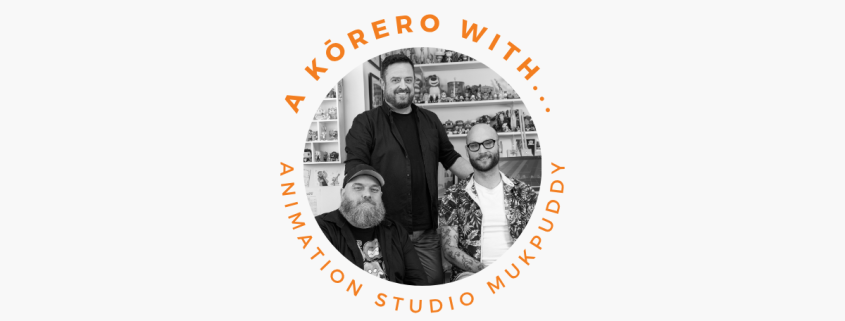
As a follow-up to this year’s Animation Matchmaking series, DEGANZ’s Izzi Hoskyn sat down with Ryan Cooper and Alex Leighton, two-thirds of the team leading Mukpuddy Ltd.
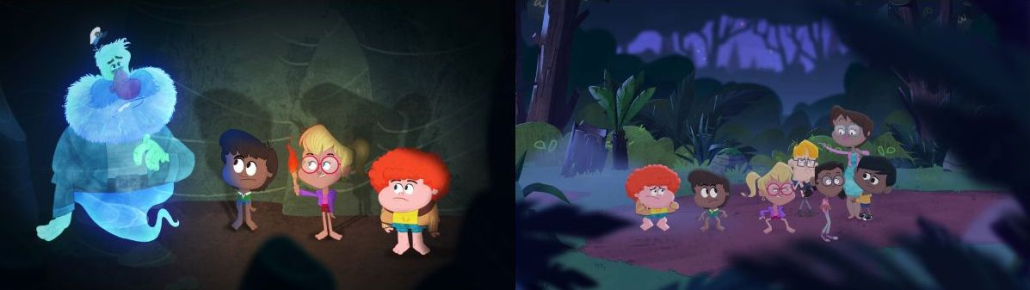
Mukpuddy originated from humble beginnings in 2002, starting in a basement before evolving into Aotearoa’s leading 2D animation studio. The team has created original shows, such as The Barefoot Bandits, Jandal Burn, and Night Eyes, as well as adapted Spike Milligan’s iconic Badjelly the Witch to the screen. Mukpuddy has solidified itself as a cornerstone of local animation, crafting worlds with a distinct style and humour appealing to audiences both locally and internationally.
In this kōrero, Ryan and Alex discuss the animation process, the secret actor living inside every animator, and some tips for local creatives to step into the world of animation themselves.
Izzi: So the first question is a biggie, but in fairly simple terms, what does the animation workflow look like?
Ryan: It all starts with us coming up with an idea we want to make. From the script, it goes into a combination of the voice recordings and storyboarding. Our storyboarders will jump into dissecting the script and start asking us for direction on how we see things. Then, background artists can start to get a sense of what environments we’ll need. The riggers can also start seeing what characters we need to begin building.
Alex: Character design also usually starts around the brainstorming and writing stage, depending on the project.
Ryan: And that’s quite nice for writing because you can picture the character in your head. Sometimes, we also know the voice actor you want, so you can write the character based on that as well.
Once we have the storyboards and the voices recorded, they are then sent to an animatic editor. They’ll compile all the storyboards and voices into a rough assembly so that we can see whether the episode is working before we begin animating. That’s where we’ll sometimes throw in temporary music, sound effects, and play with the vocal performances.
That’s the upside to animation: we can see whether the finished thing is going to be successful from early on.
Alex: Animation is very heavily loaded at the front end of production before animators even touch anything, especially if you’re building a new concept from scratch.
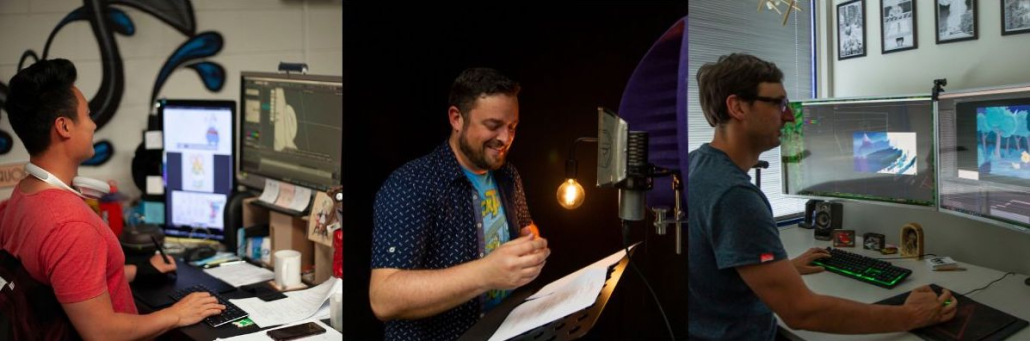
Stages of the animation workflow from character rigging, to voice recording, to compositing / Photos provided
Ryan: From there, it’s basically divvied out. An episode gets chopped up into its scenes and handed out to the animators. An animator can animate anywhere between 5 to 15 seconds a day, depending on the complexity of a shot.
Once the animation’s done, it goes to compositing. Compositors take the backgrounds, character animation, and any effects animation and put them all together to make it look extra pretty. You can add far more cinematic depth to something with techniques like focus pulls, lighting, or particle effects, which make it stand out from the average animated cartoon.
At that stage, we start looking at the final music, whether it’s production library music or a custom score. Then it’s all mixed, and that’s it.
Izzi: It’s interesting that you’re basically doing the edit before the project is even made.
Alex: That’s so important because then you’re not wasting an animator’s time and energy on something that might end up getting cut. We’ve probably cut one or two scenes from any of our projects after it’s been animated, but the hope is to avoid that.
Because our entire career hinges on storyboarding and animatics, it’s wild to think that live action doesn’t always do that. It’s a crucial part of the process for us.
Izzi: It’s a very different medium, and I think it’s reflective of the pace at which live action can be made versus animation.
Alex: Exactly, a film shoot can be six weeks, but Badjelly was over 70 weeks of work in total. Different departments were on for various lengths, but it’s a long production. That’s why we advocate for support in the animation sector because it creates jobs for longer.
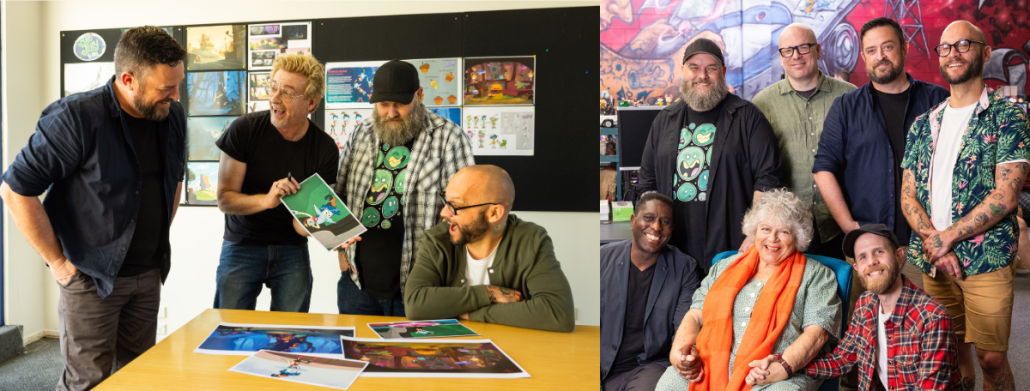
From the making of ‘Badjelly’ / Photos provided
Izzi: Could you also talk a bit more about how an individual animator will step into the process?
Ryan: We’re really big on animators bringing a piece of themselves to their scenes and taking creative liberties. Sometimes, we get a different vocal performance than we expected, so the storyboards don’t quite match. For instance, if we have a comedian in and they’re ad-libbing, we want the animators to match that.
Animators are actors in a way. They have to know how a person is going to react, how they look with certain emotions, comedic timing, and all that. It’s always exciting to see what can come out of a really talented animator who has a secret actor living inside them.
Alex: For Badjelly, we suggested that the animators film themselves acting out scenes. It gives them the chance to embody the character. That’s the moment the show comes to life in a lot of ways. You know, the characters are moving, blinking, and talking. We have a big emphasis on acting and reminding people that you don’t just act with your whole body. Sometimes it’s a subtle eye dart or a little hand gesture.
We also keep an open-door policy if animators want to come and talk to us as the directors. They have their team leaders whom they report to on a day-to-day basis, but if they want to speak to us as directors, we’re always open to a chat because we love getting into the nitty-gritty of it. Often, animators will come to us and ask, “What’s the emotion?”
Ryan: Or “What do you think the character is really meaning when they’re saying this?” It’s fun to talk about, you know, it’s a silly cartoon, but there’s real depth there.
Izzi: I was going to ask about where creativity comes into the technical aspects of animation, but it sounds like it’s just acting through drawing?
Alex: It is very technical, but the performance art of it all is what so many animators love about it.
Izzi: How do you maintain consistency in a character’s ‘performance’ if you have multiple animators working on them across various scenes or episodes?
Ryan: As the directors, we’ll try to set those boundaries up front. We might say, “This is a cartoon, but the physics are real.”
For a show like The Barefoot Bandits, the idea was that fantastical things are happening in this world, but the three main kids are grounded in reality. They can’t stretch and do things that SpongeBob could do, or magically pull things from behind their back. It’s quite fun when you set those rules because the boundaries can make for really interesting animation choices.
The Barefoot Bandits / Stills provided
But it’s also just a matter of all the animators being able to see what the others are doing. Sometimes one person sets the tone, and everyone agrees that’s what it should be. It may require a bit of looking back and forth, but people often check to see who has tackled a character first. It happens naturally, and vocal performance also helps.
Alex: If an actor’s performance is very low-key, then there’s no need to go big with their animation.
Izzi: Who else in the production does an animator work closely with?
Ryan: They often work closely with background designers because if a character is interacting with the background, the animator will need to have the final version of it before animating the actions. They also work closely with compositors. They may have a set of expectations of what needs to be delivered, whether it’s just a technical file or if they have some other ideas of what could make it look extra good in the final product. And riggers, who make the characters. They can get feedback from the animators, asking for tweaks to the way a character is built.
Izzi: Mukpuddy is both creating your own IP and working with other studios or companies. Is there something that you wish collaborators knew before approaching you for a project?
Alex: If it’s a service gig where someone comes to us with an idea and we animate it, it’s important to know what your budget is, be honest about it, and have some kind of knowledge of what we do and what our studio makes. Also, having an understanding of how a budget dictates the scope of an animated project. We don’t just point and shoot a camera. Everything on screen is designed, drawn, rigged, and then integrated into the animation pipeline. It’s time-consuming and a tricky medium to come into naively.
Also, having as many reference materials and resources as possible is really helpful, so we’re not taking a stab in the dark when we come on board.
Ryan: I think a good thing for people to know before they get into this stuff is to put ego aside. The thing you’re making is important, but it’s always nice to take the path of least resistance. Obviously, you want to stand your ground on things you believe in, but it’s good to check whether that’s just pride getting in the way.
Alex: It’s a collaboration all the way through. Which is true for the entire screen industry, but in animation, it just feels like there’s an extra layer. Everybody needs to communicate in a healthy way to get the job done.
Ryan: Consideration for people next in line is a big one. So, when I’m writing, I ask myself, “Do I need to include this prop in this scene? Is this important?” And if the answer is no, I just get rid of it straight away because someone will be spending a lot of time on that one prop.
Alex: Or you’ll ask, “Have we seen this prop in a previous series? Was there a mug or a cup, or a pen?” I’ll check, and if yes, then sweet, we can reuse it.
Ryan: Or if not, is there something else I could use for this gag that would have the same impact? Knowing that someone is next in line to do their part of the job and trying to hand it off as kindly as possible is great.
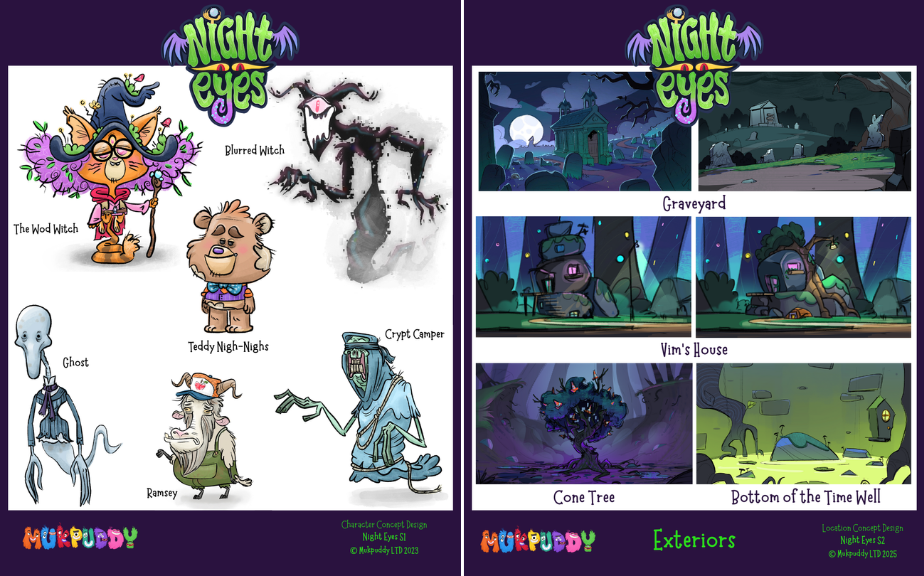
Character and Location Concept Designs for ‘Night Eyes’ / Photos provided
Izzi: What would you recommend to people who want to get into animation in Aotearoa, whether they are animators or those who want to write or direct for animation?
Ryan: Keep absorbing what’s out there. Have your finger on the pulse because inspiration can come from anywhere. The people who do best are those who know what’s happening in the industry. They know what cartoons kids are watching these days, who’s making those shows, who’s directing them, and who’s designing the characters.
Alex: The people who have longevity in the industry are the people with the ambition and the love of it. You know, meet with your peers and make a little animation gang to create stuff together.
Also, upskill where you can. If you know how to animate in Flash, maybe you can get some work animating in Toon Boom. So learn a few different softwares.
Ryan: As Ross Geller famously said: pivot. The road can get a little bit windy, but as long as you’re related to the thing you want to do, I think that’s pretty good.
We’ve had crew members who have jumped from animation to rigging and from storyboarding to background art and vice versa. Being a jack of all trades is useful. At the very least, having an understanding of who the other roles are in the industry is great because you might find yourself being in one of those roles from time to time.
And the last thing is just talk to the studios that are out there. The more you pick the brains of the people who’ve been in it for a long time, the more skills you’re going to pick up. So here in New Zealand, talk to us, Flux, Yuk Fu, speak to any of these people.
This interview has been edited for brevity and clarity.
http://degnz.sensedesign.co.nz/wp-content/uploads/2025/11/A-Korero-With.-Animation-Studio-Mukpuddy.png6751200admin/wp-content/uploads/2021/10/DEGANZ_logo_home.pngadmin2025-11-20 11:30:012025-11-20 15:15:43A Kōrero with Animation Studio Mukpuddy