
View from the Top banner

It’s election year.

We need to examine what each of the main parties’ views are on the Screen industry, Arts, Culture and Heritage, as well as what they are going to do for society and the economy. Here’s a first cursory look from a screen perspective.

To date, NATIONAL has shown its hand. Funding cuts for Screen and Arts. Maintenance of the New Zealand Screen Production Rebate NZSPR International. The NZSPR Domestic is currently under review. As is the possibility of a levy on streamers. No Arts policy on the website. It doesn’t seem to fit in “Fixing the Basics” and “Building the Future”. I’d have to admit to being pleasantly surprised by MCH Minister Paul Goldsmith. When he took over from Melissa Lee, I thought, “Here we go…not.” Goldsmith, it turns out, is willing to listen, learn, and it seems to do what he can for Arts and Screen while sitting in a party that’s not showing a whole lot of interest in us.

LABOUR is pretty much bereft of policy at this point. Intentionally, they kept telling us. And it’s supposedly working for them if you look at the polls. Reuben Davidson, Labour’s Media and Communications spokesperson, is in on the streamer levy if they get back into power, though. We’ll just have to wait to learn what else they have to offer. Labour has, as we know, always been a strong supporter of Screen and the Arts. And in Davidson and the Arts, Culture and Heritage spokesperson Rachel Boyack, we have two keen supporters.

ACT would do away with the NZSPR altogether if they had their way. Nothing in the way of policy on Arts on their website, which pretty much tells us all we need to know.

The GREENS are speaking our language with a full Arts, Culture and Heritage Policy on their website here. Nuff said.

TE PĀTI MĀORI tells us: “Hang tight! We’re working on our policies and will be back soon.” Don’t expect a huge amount of attention from this direction for screen in general, though. Past policy has been primarily focused on Māori Arts, Culture and Heritage, as you would expect from a Māori party.

Over at the OPPORTUNITY PARTY, former Labour Party Minister Iain Lees-Galloway is General Manager for the fifth leader there in 10 years, Quilae Wong. Their focus is the environment and business, mainly, it seems. Nothing to say on their website about the Arts at this point. A ‘wait and see’ here.

I forgot about Winnie… a late addition here. Go to the NEW ZEALAND FIRST website and the latest policy they’ve got there is for 2023. They obviously think they’re such a shoo-in they don’t have to worry. If we go back in time to their ’23 manifesto, Media gets a reasonable amount of attention but not the Arts. Jenny Marcroft, a former broadcaster, is Parliamentary Under-Secretary to the Minister for Media and Communications and NZ First spokesperson for Arts, Culture and Heritage. I don’t recollect Marcroft speaking on anything about the Arts, which possibly says a lot… about NZ First, or my memory.

In the next few months, there will be chances to hear more from all the parties on the policies that affect our industry. There is always at least one screen-focused evening with party reps in the lead-up to election day. If you can’t make it along, check party websites for policy releases and updates.

AND VOTE!

Make your voice heard.


Tui Ruwhiu
Executive Director
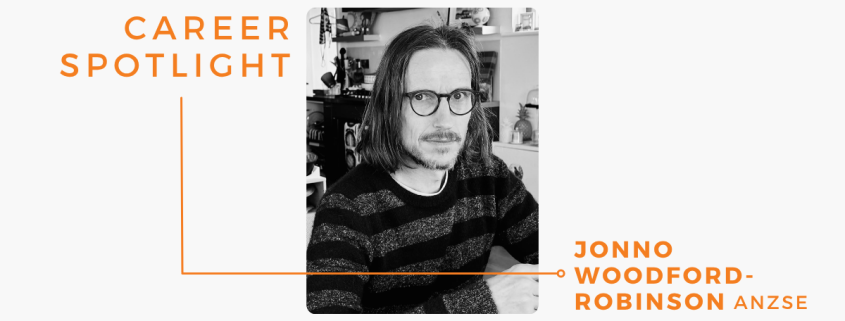
Jonno Woodford-Robinson’s career as an editor is a testament to versatility, rhythm, and a deep understanding of storytelling across genres. From blockbuster VFX spectacles to intimate indie dramas and documentaries, his work combines technical precision with a strong creative sensibility.

Born in Waihōpai Invercargill, Jonno grew up in a household where creativity was highly valued. His English father was a sculptor and art teacher, while his Irish mother taught high school English. Music became Jonno’s first creative language as he was an avid pianist and drummer, playing in his high school band and spending countless hours in the music room. This early grounding in rhythm would later shape his approach to editing, beginning with his first project at 17: a music video for his band.

After a formative summer working at a local radio station, Jonno moved to Ōtautahi Christchurch to study radio and television broadcasting, focusing on drama editing. He later relocated to Te Whanganui-a-Tara Wellington, where he began working in post-production, editing commercials, short films, and the occasional music video.

A pivotal moment in Jonno’s career came when he met Oscar-nominated editor Michael Horton. Working alongside Horton, Jonno operated Lightworks and Avid systems, developing both his story editing and technical skills. This mentorship came full circle years later when they co-edited Lee Tamahori’s acclaimed drama, Mahana (2016). Together, they won Best Editor at the 2017 New Zealand Film Awards.

Jonno’s feature film career began with the cult classic Tongan Ninja (2002), quickly followed by a series of diverse projects. These included the psychological drama Fracture (2004), the groundbreaking Rotuman film Pear ta Ma ‘on Maf (The Land Has Eyes) (2004), and Taika Waititi’s debut Eagle vs Shark (2007), both of which premiered at the Sundance Film Festival. His work on the short film Closer (2004), which screened in competition at Cannes, demonstrated his sensitivity to character-driven storytelling, earning multiple accolades at the New Zealand Screen Awards.

Alongside his editorial work,  Jonno developed an extensive VFX skill set while working for Wētā Digital’s (now Wētā FX) motion capture department in 2005 and 2006. His proficiency with Avid Media Composer and DaVinci Resolve Fusion has enabled him to seamlessly bridge traditional editing with VFX-heavy workflows, making him a sought-after collaborator on complex productions.

Throughout his career, Jonno has contributed to a remarkable range of high-profile productions. His credits include Mortal Engines (2018), The Rehearsal (2016), What We Do in the Shadows (2014), and Pork Pie (2017). He was an additional editor on Jared Hess’s box office hit A Minecraft Movie (2025) and Peter Jackson’s King Kong (2005), and part of the editorial team for The Lord of the Rings: The Two Towers (2002) and The Return of the King (2003).

In television, Jonno’s work is equally distinguished. His credits span international and local productions, including Mr. Corman (2021), Cleverman (2016-2017), and One Lane Bridge (2020). Notably, he served as lead editor on the Emmy-nominated series Time Bandits (2024), a fantasy adventure that blended improvisation with complex visual effects, an ideal match for Jonno’s hybrid skill set.

Beyond narrative, Jonno has made significant contributions to documentary storytelling. He edited and associate-produced Peter Young’s The Last Ocean (2012), a powerful environmental documentary advocating for the protection of the Ross Sea. The film screened at international festivals, won multiple awards, and played a role in the establishment of the world’s largest marine protected area.

His documentary work also demonstrates a strong ability to integrate archival material with contemporary footage, notably in Dame Gaylene Preston’s mini-series on the 2010 Christchurch earthquake, Hope and Wire (2014), and Tom Scott’s tele-feature dramatisation of the protests against the 1981 Springbok tour, Rage (2011).

Most recently, Jonno edited Chelsie Preston Crayford’s debut feature, Caterpillar (2026), a drama exploring the dynamics of three generations of women facing a life-changing event, continuing his focus on character-driven storytelling.

In addition to his vast career in post-production, Jonno has been a longtime supporter of DEGANZ and is committed to helping usher in the next generation of editors. He has been a mentor to many, taking on various editor attachments over the years. He was also a key player in the establishment of the Aotearoa New Zealand Screen Editors (ANZSE) Accreditation. He is currently serving on the ANZSE committee, helping to evaluate the next round of Accreditations.

Based in Te Whanganui-a-Tara Wellington, Jonno lives with his wife Rieko, an artist, surrounded by inquisitive wild birds and a wide selection of teas.


View from the Top banner

Petrol and diesel are inescapable costs for production.

It doesn’t matter if it’s a two-person crew with a director, or a 3-500 crew on an international show; they all need fuel, particularly diesel.

Gaffer, grip, and unit trucks, four wheel drives, SUVs, vans, personal cars—all those production vehicles clock up the mileage, and the IRD rate of approximately $1.20 isn’t cutting it any more.

I just filled up my 4WD, and it was $3.99 a litre for diesel.

Productions, whether in planning, prep, or underway, will be looking sideways at their contingency and overhead and at ways to cut costs. And of course, thought will turn to cast and crew rates and how to squeeze them.

Collectively negotiated agreements under the Screen Industry Workers Act, should we achieve them, will provide some protection for cast and crew in this case, and any other. Production will not be able to go below the base negotiated rate, preventing the worst cases of exploitation. So the old chestnut of: “If you won’t accept this terrible offer, we’ll find someone else,” will be harder to pull off, because the occupational negotiated base rate will apply to everybody. In other words, there will be a floor that will be impossible to go below. And it won’t just be base rates that will be negotiated. Occupational terms and conditions will also be on the table for discussion.

Collective agreements will help to deal with the cowboy producers and productions. And there are a few. We are fortunate, though, that most producers try to do the best they can for those who work for them.

We are all facing an uphill battle right now, which has been made worse by the Middle East situation. Rising costs were an issue before that mess happened. And will remain so even if a way through that disaster is found.

New Zealand’s funding bodies are going to have to factor all of this in going forward. Production budgets will rise, and not just because of the cost of petrol and diesel. There are myriad other things that have gotten costlier.

In the meantime, spare a thought for your producer, line producer, and production manager who are grappling with how to make budgets work right now. Just make sure you are not the one paying for it.


Tui Ruwhiu
Executive Director


View from the Top banner

The world is awash with bad news at the moment, whether it’s the war in the Middle East, the planned shutterings announced by Heinz Watties and McCain in Hawkes Bay, or the lack of domestic and international production in Aotearoa this year.

It’s with a great deal of pleasure, therefore, that I got to watch director and DEGANZ board member Rebecca Tansley’s extremely feel-good documentary film Tenor: My Name Is Pati.

Having hit No. 1, it now sits at No. 2 at the NZ box office with $399,926 after just its second week in theatres.

I was fortunate to have seen the film a couple of months ago, together with a majority Pacific Island community in attendance. Then two weeks ago, we held a joint screening of the film together with WIFT at the Bridgeway in Birkenhead, with a mixture of Bridgeway, WIFT/DEGANZ attendees and others.

At both screenings, there was laughter, shouts of joy and even the occasional tear as the audience followed the hero’s journey of Pati from singing in a South Auckland resthome as a kid to the role as an adult of the Duke of Mantua in Verdi’s Rigoletto at the Metropolitan Opera House in New York.

Film has a wonderful ability to transport the soul, and Rebecca’s film did it with ease. An engaging protagonist (together with his brother Amitai and other family members). A journey filled with trials and tribulations. Wonderfully crafted. And an outcome that was rapturous in its climax, which for me was when Pati knew he had clinched the recording performance of Nessun Dorma under demanding task master, conductor Emmanuel Villaume. At the Bridgeway, the audience burst into spontaneous applause at this pivotal moment.

We should all applaud the addition of this film to New Zealand’s cinematic heritage.

DEGANZ is recognising all New Zealand filmmakers’ collective efforts this month, along with many other guilds and associations, by supporting a promotion created by Piki Films celebrating New Zealand cinema. The promotion will be part of their 10-year anniversary celebration re-release of another Kiwi film that warmed NZ hearts while highlighting child neglect—Taika Waititi’s Hunt for the Wilderpeople.

In the trying times that we are in as a screen sector in New Zealand, it’s never been more important to support our local screen talent, their work, and the contributions they and their films and programmes make to New Zealand identity, culture and society.

In the feedback we have just given to the government on the proposed changes to the New Zealand Screen Production Rebate – International 5% Uplift, we, along with all of the other above-the-line guilds and associations, stressed the need for the 5% Uplift to meaningfully advance our domestic sector and its talent, otherwise we risk becoming a country that only services international production. That’s no laughing matter.

Pati, though, was good for a laugh, some nice warm fuzzies, and a welcome escape from the uncomfortable reality that surrounds many of us.

Although I’m an arthouse fan at heart, I equally appreciate the pleasures that feel-good films like Pati give us.

Get along if you can. You won’t regret it.


Tui Ruwhiu
Executive Director

View from the Top banner

I remember the first director’s training session for TV I attended now many years ago. Our workshop facilitator, John Harris, who went on to establish production company Greenstone, told us that one way to think of directing was like shopping: we had a shopping basket, and we had to fill it up for the editor with the right ingredients. A simple metaphor, but it worked for me at the time.

More importantly, I believe, it highlighted the importance of the editor to the creative process of crafting a story for the screen.

Editors too often are undervalued for the work they do. It’s not just about pushing buttons. It’s about utilising their creativity, knowledge and skill to elevate the material they’ve been given, which sometimes can be less than ideal.

An editor can save a director’s bacon, and often does, in factual and in narrative.

Like directing, editing is both an art and a craft. It’s one of the reasons that DEGANZ has established the Aotearoa New Zealand Screen Editor accreditation. To give the art and craft of editing its proper due when executed at a consistently high standard.

Unfortunately, editing and assistant editing can suffer from a lack of respect in the production process, especially when budgets are tight. This is unfortunate because it’s a false economy to seek to skimp in these areas and can ultimately mean budget and time are wasted, to the detriment of the project.

Another major area of concern for the Guild is the replacement of editors, particularly on feature films. Yes, failing relationships between director and editor can sometimes necessitate a change in direction. But the editor can sometimes bear the brunt of failure in other areas or because of external pressure exerted from distributors and sales agents on directors, producers and executive producers. Would a director or other HOD be replaced so easily? Of course not.

There are significant negative health and wellbeing outcomes that manifest for editors when they are replaced, particularly when it is handled poorly, as is often the case.

Equally concerning is the replacement or marginalisation of the assistant editor role. Working editors will all attest to the vital importance of this mahi and the detrimental effect on effective, efficient, quality post-production from losing assistants to ‘combo deal’ approaches from post houses, or the failure of producers to allow for, or enough time for, assistant editors to do the vital work they do.

DEGANZ also does not support the practice of multiple editors being contracted to work on a feature film. There can certainly be a need to bring in an outside editor consultant at times, to help the director and editor team look at the project with a fresh set of eyes. The hiring of multiple editors to execute a film, though, is a sausage-factory approach to the cinematic, artistic endeavour that does not recognise nor value the director-editor creative collaboration appropriately.

The DEGANZ board is now looking at how to best address these issues and is liaising with international editor bodies, examining best  practices, as well as engaging with local practitioners and entities to see what learnings and ideas we could utilise to effectively achieve outcomes that will benefit individuals and projects.

Editing is an art and craft that can make or break a project, and it deserves to be recognised for the crucial part it plays in the production process.


Tui Ruwhiu
Executive Director